
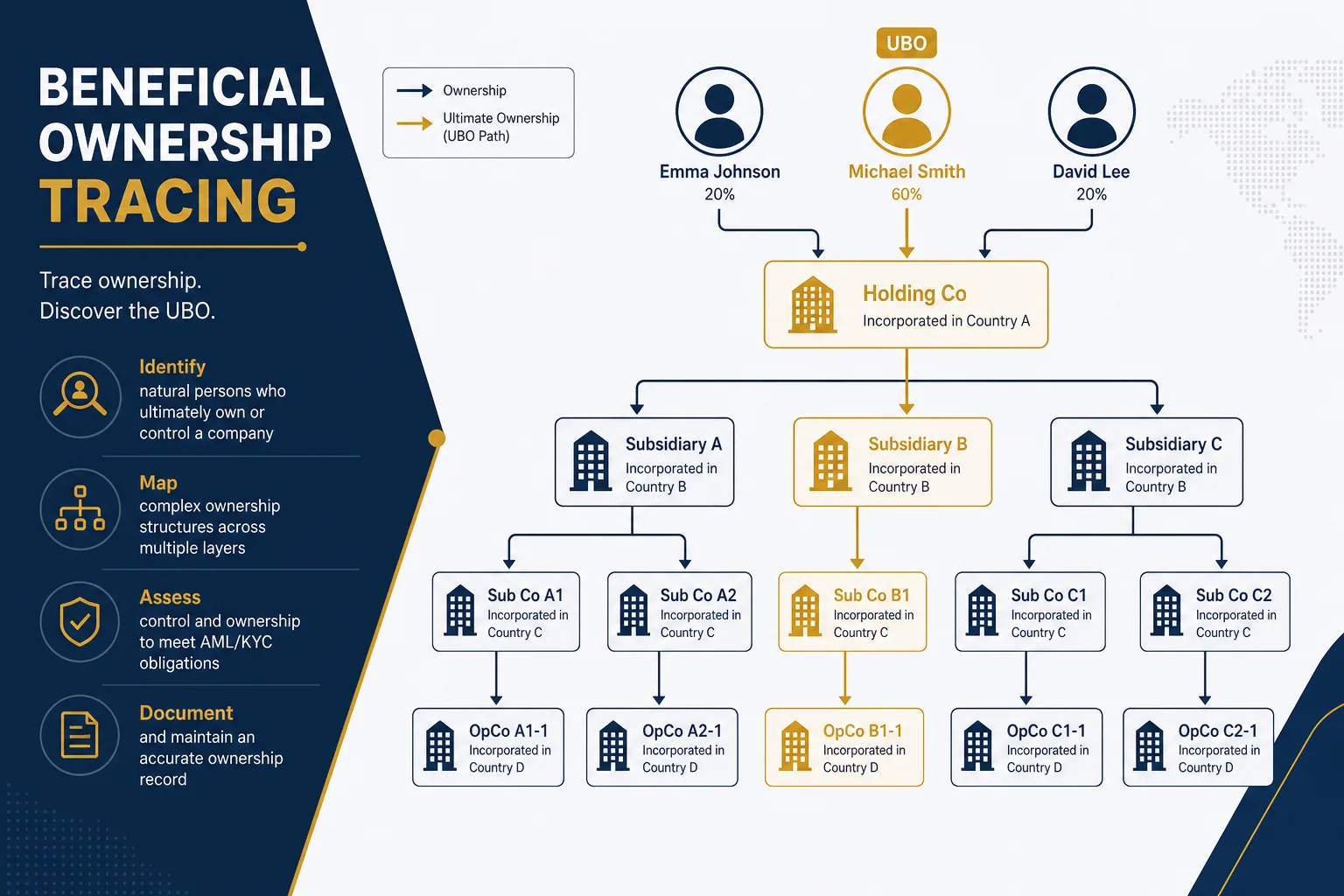
Beneficial ownership tracing is the work of following ownership and control relationships until you identify the natural persons who ultimately own or control a company—the ultimate beneficial owners (UBOs). It sounds straightforward. In practice, it is one of the hardest, most time-consuming tasks in AML and KYB compliance.
As businesses scale globally, manual ownership checks break down. Multi-layer holding companies, cross-border entities, shell companies, trusts, nominee shareholders, and fragmented registries make it nearly impossible for compliance teams to trace beneficial ownership reliably at volume without automation.
That is why modern organizations are shifting from spreadsheet-and-registry hunts to automated ownership intelligence—systems built to perform beneficial ownership tracing as a data problem, not a one-off research project.
Quick Answer: What Is Beneficial Ownership Tracing?
Beneficial ownership tracing is the process of identifying the natural persons who ultimately own, control, or benefit from a business entity by analyzing ownership structures, corporate hierarchies, and regulatory data sources. It goes beyond collecting a declared owner name: it follows indirect ownership across multiple entity layers and jurisdictions until control and ownership thresholds are met.
For a foundational overview, see how UBO identification works. For global regulatory requirements, see our UBO identification and verification requirements guide.
Why Manual Beneficial Ownership Tracing No Longer Works
Manual beneficial ownership tracing traditionally relies on analysts reviewing documents, searching registries, and mapping ownership structures in spreadsheets. That can work for small volumes. It fails in modern compliance environments for several reasons.
1. Increasing Corporate Complexity
Modern ownership structures often include:
- Multi-layer holding companies
- Offshore entities
- Trust arrangements
- Nominee shareholders
- Private investment vehicles
Each layer increases the difficulty of tracing ultimate ownership. For a deeper look at layered structures, see complex ownership structures and beneficial ownership.
2. Cross-Border Data Fragmentation
Beneficial ownership data is distributed across:
- National corporate registries
- Local business authorities
- Private databases
- Regulatory filings
- Non-standardized documentation
No single source provides a complete global view.
3. Time-Intensive Manual Investigations
Manual ownership tracing requires:
- Searching multiple registries
- Translating foreign documents
- Calculating ownership percentages
- Validating indirect ownership chains
This can take hours or even days per entity.
4. High Risk of Human Error
Manual processes are vulnerable to:
- Miscalculated ownership percentages
- Missed indirect ownership links
- Outdated registry information
- Data entry errors
Even small mistakes can lead to compliance failures.
5. Scaling Limitations
High-growth companies onboarding thousands of customers per month cannot rely on manual investigation teams.
The process simply does not scale economically or operationally.
What Modern Beneficial Ownership Tracing Actually Involves
Modern beneficial ownership tracing is no longer a manual research exercise. It is an intelligence-driven process powered by structured data, automation, and entity resolution technology.
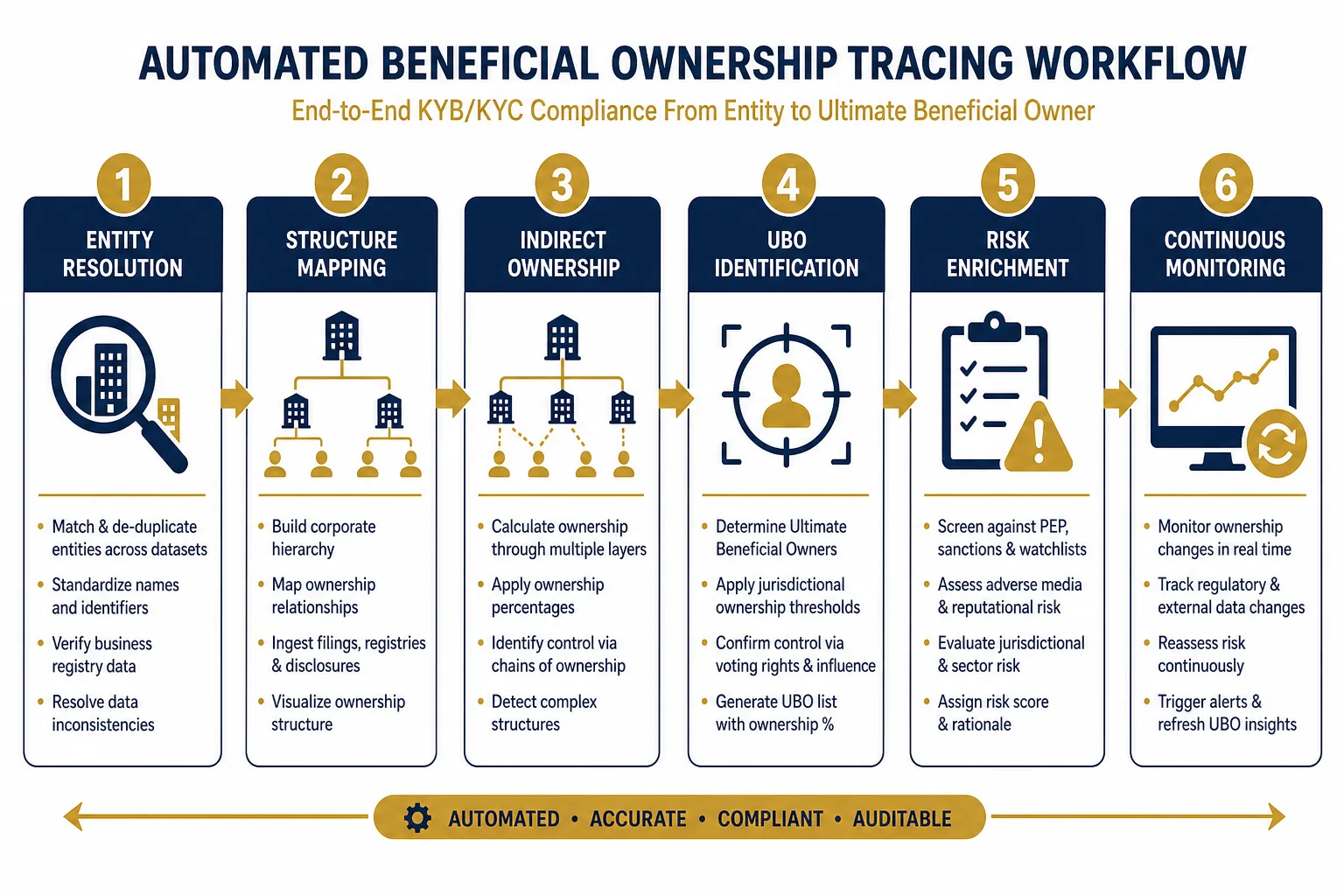
Step 1: Entity Resolution
The system first identifies and normalizes company data across multiple sources to ensure consistency.
This includes:
- Company name matching
- Registration number validation
- Jurisdiction alignment
Step 2: Ownership Structure Mapping
Automated systems build a full ownership graph that includes:
- Parent companies
- Subsidiaries
- Shareholding relationships
- Cross-border connections
This creates a visual representation of ownership flow.
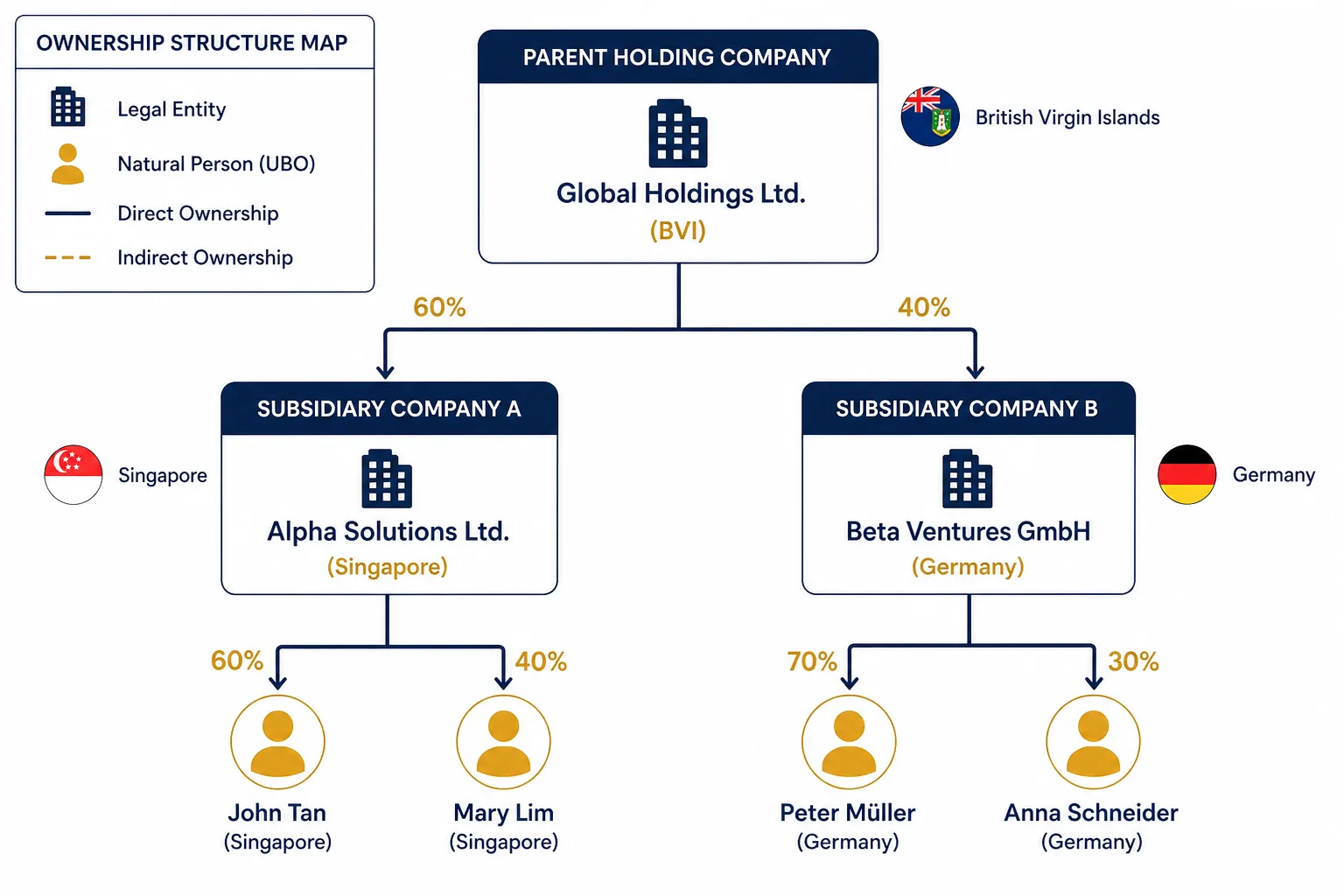
Step 3: Indirect Ownership Calculation
Advanced systems calculate:
- Percentage ownership across layers
- Control relationships
- Voting rights influence
This ensures accurate identification of UBOs even in deeply nested structures.
Step 4: Beneficial Owner Identification
The system isolates natural persons who meet:
- Ownership thresholds (e.g., 25%+)
- Control-based definitions
- Regulatory criteria for UBO classification
UBO identification and verification platforms automate this step while keeping compliance teams in control of risk decisions.
Step 5: Risk Enrichment
Once identified, UBOs are enriched with:
- Sanctions screening data
- PEP status
- Adverse media signals
- Jurisdictional risk indicators
Integrating AML screening at this stage connects ownership intelligence to broader financial crime controls.
Step 6: Continuous Monitoring
Automated systems track changes such as:
- Ownership transfers
- New shareholders
- Corporate restructuring
- Risk profile updates
Ongoing due diligence keeps ownership records current throughout the customer lifecycle.
Manual vs Automated Beneficial Ownership Tracing
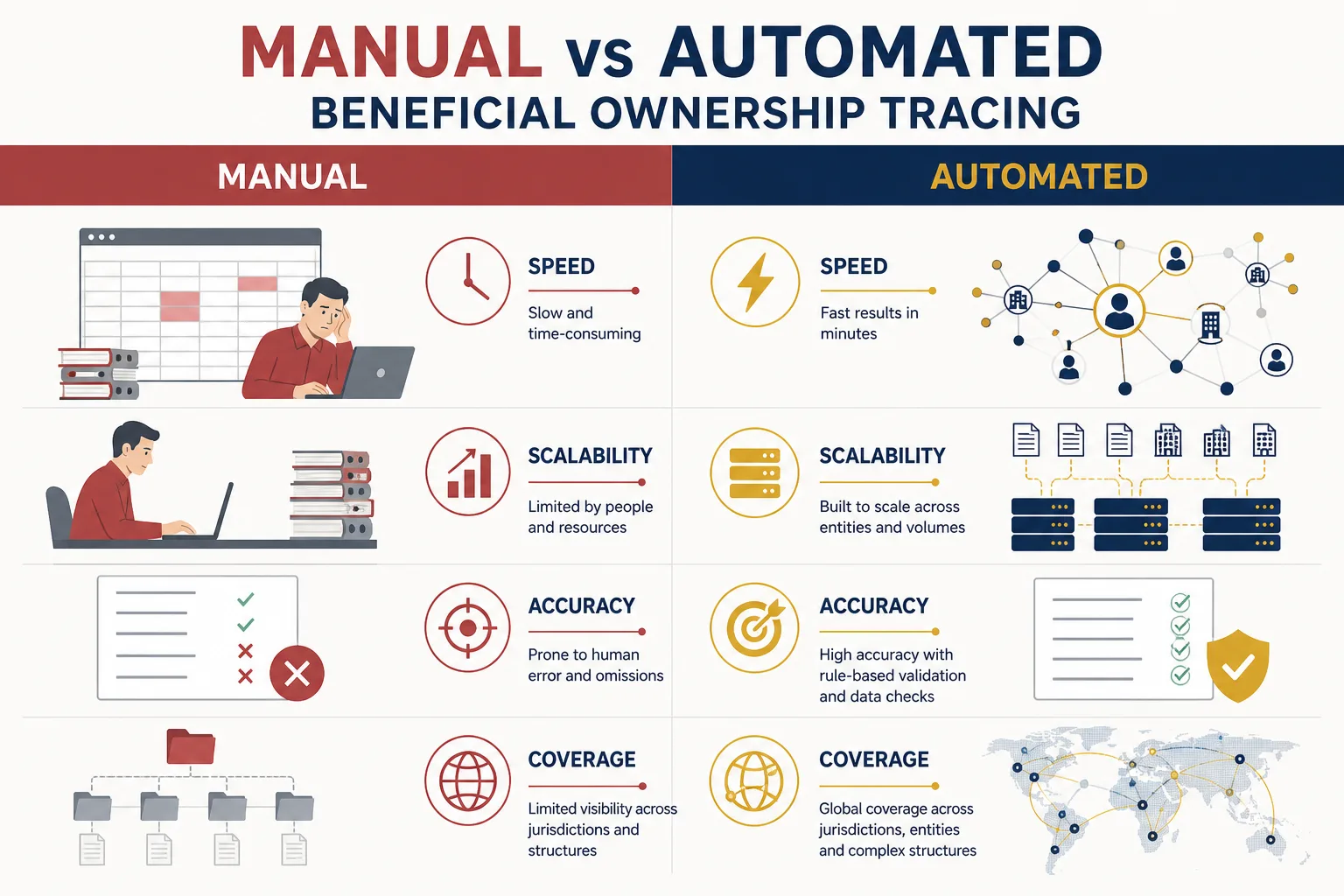
| Factor | Manual Approach | Automated Approach |
|---|---|---|
| Speed | Slow (hours/days per entity) | Real-time or near real-time |
| Scalability | Low | High |
| Accuracy | Variable | Consistent |
| Cost | High labor cost | Lower marginal cost |
| Coverage | Limited sources | Global multi-source coverage |
| Monitoring | Difficult | Continuous |
Why Beneficial Ownership Tracing Is a Data Problem, Not a Research Problem
A key misconception in compliance is treating beneficial ownership tracing as investigative research.
In reality, it is a data aggregation and relationship mapping problem.
The challenge is not intelligence gathering—it is:
- Connecting fragmented datasets
- Resolving entity identities across systems
- Tracing ownership across jurisdictions
- Maintaining updated ownership graphs
This is why automation and data infrastructure are essential.
Industries Most Affected by Ownership Tracing Challenges
Fintech and Payments
High onboarding volumes and fraud risk require rapid beneficial ownership tracing during merchant onboarding. See how fintech and payment providers approach UBO compliance.
Banking and Financial Institutions
Regulated banks must perform detailed KYB and ongoing ownership monitoring across all corporate clients. AML compliance software for financial institutions integrates ownership tracing into broader programs.
Crypto and Digital Assets
High-risk exposure and global onboarding demand enhanced ownership transparency.
Insurance and Lending
Risk-based onboarding requires clear understanding of corporate ownership structures. Apply a risk-based AML approach to prioritize enhanced tracing for higher-risk entities.
Regulatory Pressure Driving Automation
Regulators are increasingly expecting:
- Faster onboarding without reduced compliance quality
- Accurate and up-to-date ownership records
- Evidence-based UBO identification
- Continuous monitoring of ownership changes
Frameworks such as FATF recommendations and national AML / customer due diligence rules reinforce the need for reliable beneficial ownership transparency.
The Risks of Failing Beneficial Ownership Tracing
Organizations relying on manual processes face significant risks:
- Onboarding sanctioned or high-risk entities
- Regulatory fines for AML failures
- Reputational damage
- Fraud exposure
- Inaccurate risk scoring
- Audit failures
These risks increase as transaction volumes grow.
How Automation Solves Beneficial Ownership Tracing at Scale
Modern ownership intelligence platforms solve core scalability challenges through:
1. Global Data Aggregation
Combining data from:
- Corporate registries
- Ownership databases
- Regulatory filings
- Commercial intelligence sources
2. Entity Resolution Technology
Ensuring consistent identification of companies and individuals across systems.
3. Ownership Graph Modeling
Building dynamic visual and computational ownership structures.
4. AI-Assisted Interpretation
Helping resolve:
- Complex ownership chains
- Ambiguous corporate structures
- Cross-border inconsistencies
5. Real-Time Updates
Continuously updating ownership records as corporate structures change.
Best Practices for Modern Beneficial Ownership Tracing
Move From Manual to Data-Driven Processes
Organizations should shift from spreadsheet-based workflows to structured data systems.
Standardize Ownership Data
Use consistent formats for:
- Company identifiers
- Ownership percentages
- Entity relationships
Integrate Ownership Tracing Into KYB
Beneficial ownership tracing should be part of business onboarding—not a separate compliance step.
Use Continuous Monitoring
Ownership structures are dynamic. One-time checks are insufficient.
Prioritize High-Risk Entities
Apply enhanced tracing techniques for:
- Complex structures
- Offshore entities
- High-risk jurisdictions
Beneficial ownership verification should document both the source and the reasoning used to reach each conclusion.
The Future of Beneficial Ownership Tracing
Beneficial ownership tracing is evolving toward:
- Fully automated ownership intelligence networks
- Real-time global corporate transparency graphs
- AI-driven entity relationship interpretation
- Regulatory-connected ownership registries
- Predictive risk scoring based on ownership patterns
The direction is clear: manual investigation will continue to decline as automation becomes the compliance standard.
Conclusion
Beneficial ownership tracing has evolved from a manual investigative task into a data-intensive, automation-driven compliance function. As corporate ownership structures become more complex and globalized, manual processes simply cannot keep up.
Organizations that adopt automated beneficial ownership tracing gain faster onboarding, improved accuracy, reduced compliance costs, and stronger risk visibility.
In modern AML compliance, scalable ownership tracing is not optional—it is essential.
Automated Beneficial Ownership Tracing with ClearDil
Frequently Asked Questions
What is beneficial ownership tracing?
Beneficial ownership tracing is the process of following ownership and control relationships to identify the natural persons who ultimately own or control a company, using corporate structures and regulatory data.
Why does manual beneficial ownership tracing fail at scale?
Manual processes are slow, error-prone, and cannot keep up with global onboarding volumes or complex, multi-jurisdiction ownership structures.
How does automated beneficial ownership tracing work?
Automation maps ownership structures across data sources, calculates indirect ownership and control, identifies UBOs against regulatory thresholds, and monitors changes over time.
What makes ownership tracing difficult?
Complex corporate structures, fragmented global data, and cross-border ownership chains make it hard to reach the natural person behind intermediate entities.
Is beneficial ownership tracing required for AML compliance?
Yes. Identifying and understanding beneficial ownership is a core requirement of KYB and AML frameworks in most jurisdictions.