
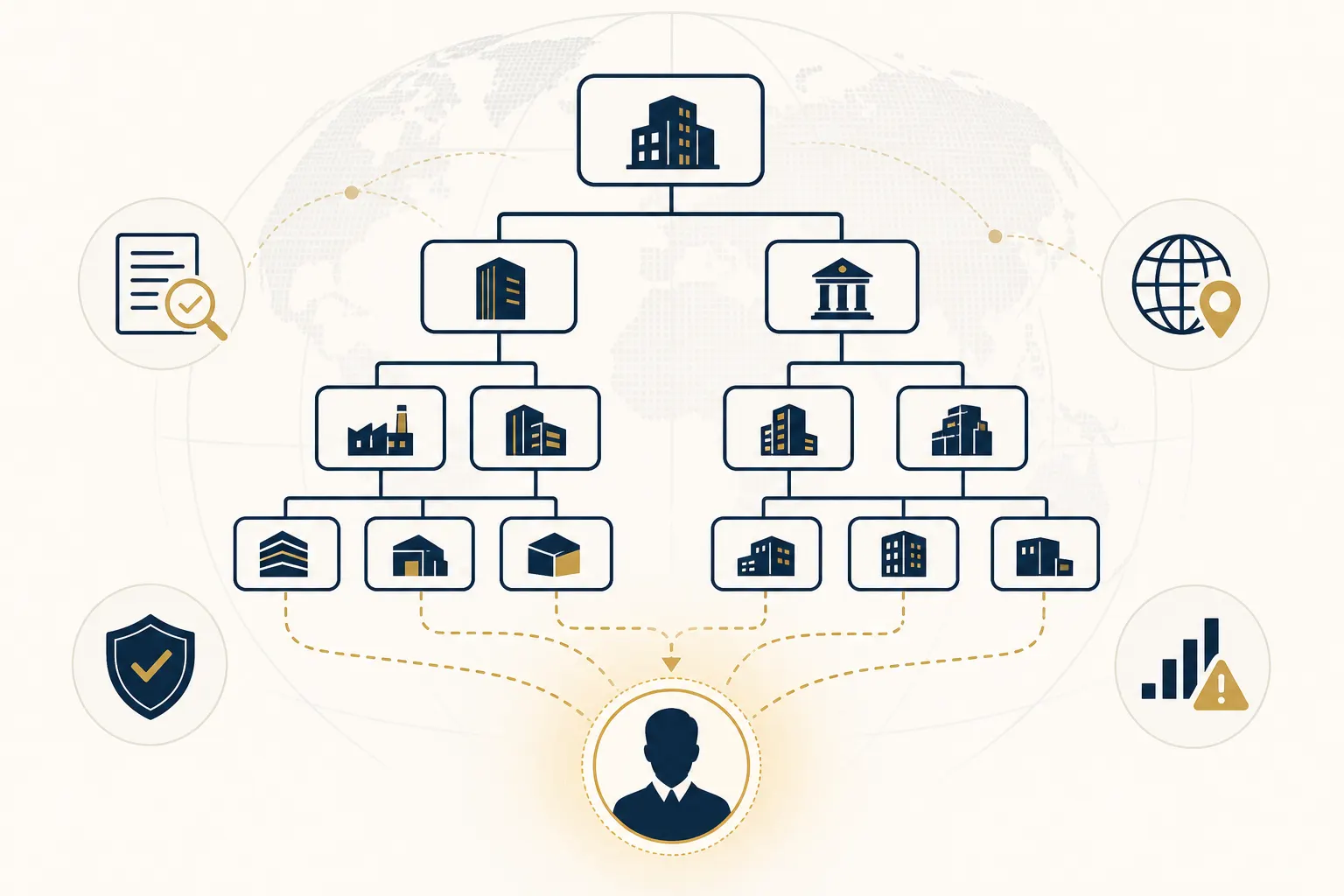
In modern AML and KYB compliance, one of the hardest challenges is ownership structure mapping across complex ownership structures. Businesses rarely operate with simple, direct ownership anymore. Instead, they are often controlled through layered entities, offshore companies, trusts, nominee shareholders, and cross-border corporate arrangements.
These structures are not always illegal—but they are frequently used to obscure ultimate beneficial owners (UBOs) and hide control relationships from regulators and compliance teams.
For financial institutions, fintech companies, and regulated businesses, failing to properly analyze ownership structures can lead to onboarding high-risk entities, regulatory penalties, and exposure to financial crime. For how teams identify natural-person owners once the structure is mapped, see UBO identification explained and beneficial ownership tracing at scale.
Quick Answer: What Are Complex Ownership Structures?
Complex ownership structures are corporate arrangements where ownership and control of a company are distributed across multiple layers of entities, jurisdictions, or legal arrangements, making it difficult to identify the ultimate natural persons who own or control the business.
These structures often involve indirect ownership chains, cross-border entities, and legal vehicles designed to separate control from visibility. Ownership structure mapping is the discipline of reconstructing those relationships until control and ownership reach natural persons.
Why Complex Ownership Structures Exist
Not all complex ownership is malicious. There are legitimate business reasons, including:
- Tax efficiency and international structuring
- Investment holding companies
- Multi-jurisdiction operations
- Risk isolation between business units
- Private equity and fund structures
However, these same structures can also be exploited to:
- Conceal beneficial ownership
- Evade sanctions screening
- Hide illicit financial flows
- Avoid regulatory scrutiny
- Layer transactions through shell entities
This dual-use nature makes them a major focus area in AML compliance.
Common Types of Complex Ownership Structures
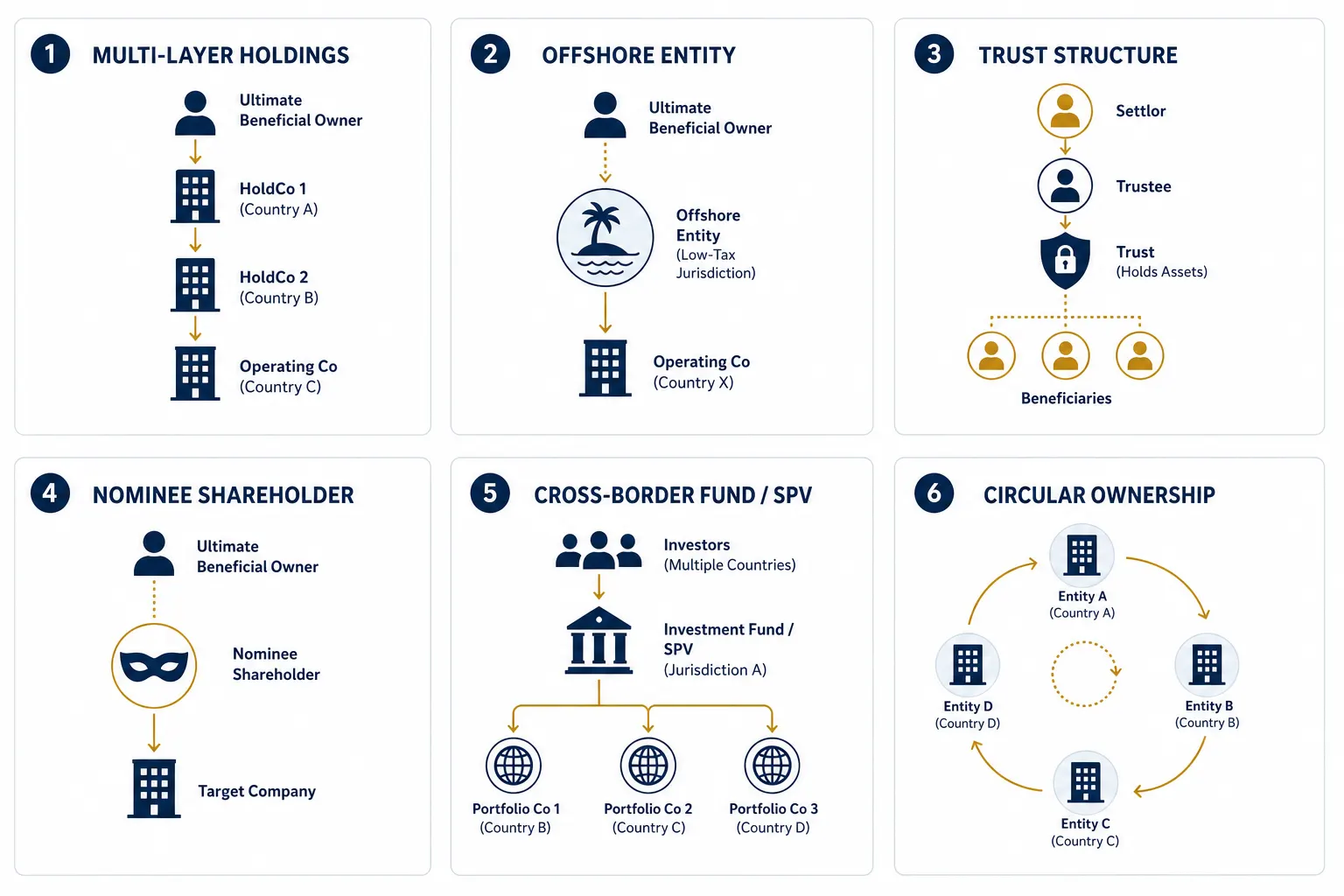
1. Multi-Layer Holding Companies
A company is owned through several layers of parent companies across different jurisdictions.
Example:
Individual → Holding Company A → Holding Company B → Operating Company
Each layer reduces transparency and increases tracing difficulty.
2. Offshore Corporate Structures
Entities registered in offshore jurisdictions are often used to create distance between ownership and control.
These structures may involve:
- Low-transparency registries
- Limited disclosure requirements
- Cross-border ownership chains
3. Trust-Based Ownership
Trust structures separate legal ownership from beneficial control.
Key roles include:
- Settlor
- Trustee
- Beneficiaries
- Protectors
Determining who ultimately benefits or controls the assets is often complex.
4. Nominee Shareholders
Nominee arrangements involve individuals or entities holding shares on behalf of the true owner.
This creates intentional separation between:
- Registered ownership
- Actual control
5. Cross-Border Investment Structures
Private equity, venture capital, and institutional investors often use layered fund structures across multiple jurisdictions.
These may include:
- Investment funds
- Special purpose vehicles (SPVs)
- Sub-funds and feeder funds
6. Circular Ownership Structures
In some cases, companies partially own each other in loops or circular relationships, making ownership calculations more complex.
Why Complex Ownership Structures Are a Compliance Risk
Complexity itself is not the problem—opacity is.
These structures create risks such as:
1. Hidden Ultimate Beneficial Owners
The real controlling individuals may be buried multiple layers deep in the structure.
2. Sanctions Exposure Risk
Sanctioned individuals may hide behind intermediaries or offshore entities.
3. Fraud and Shell Companies
Complex structures are often used to legitimize fake businesses or transaction laundering schemes.
4. Difficulty in Risk Scoring
Without clear ownership visibility, risk models may underestimate exposure.
5. Regulatory Non-Compliance
Failure to properly identify beneficial owners can result in:
- AML fines
- Licensing issues
- Regulatory investigations
- Reputational damage
Global expectations for beneficial ownership transparency are summarized in our UBO identification and verification requirements guide. Product capabilities for beneficial ownership verification and UBO identification sit next to structured KYB onboarding.
How Compliance Teams Uncover Hidden Ownership
Modern compliance teams use structured methods to analyze complex ownership—this is ownership structure mapping in practice.
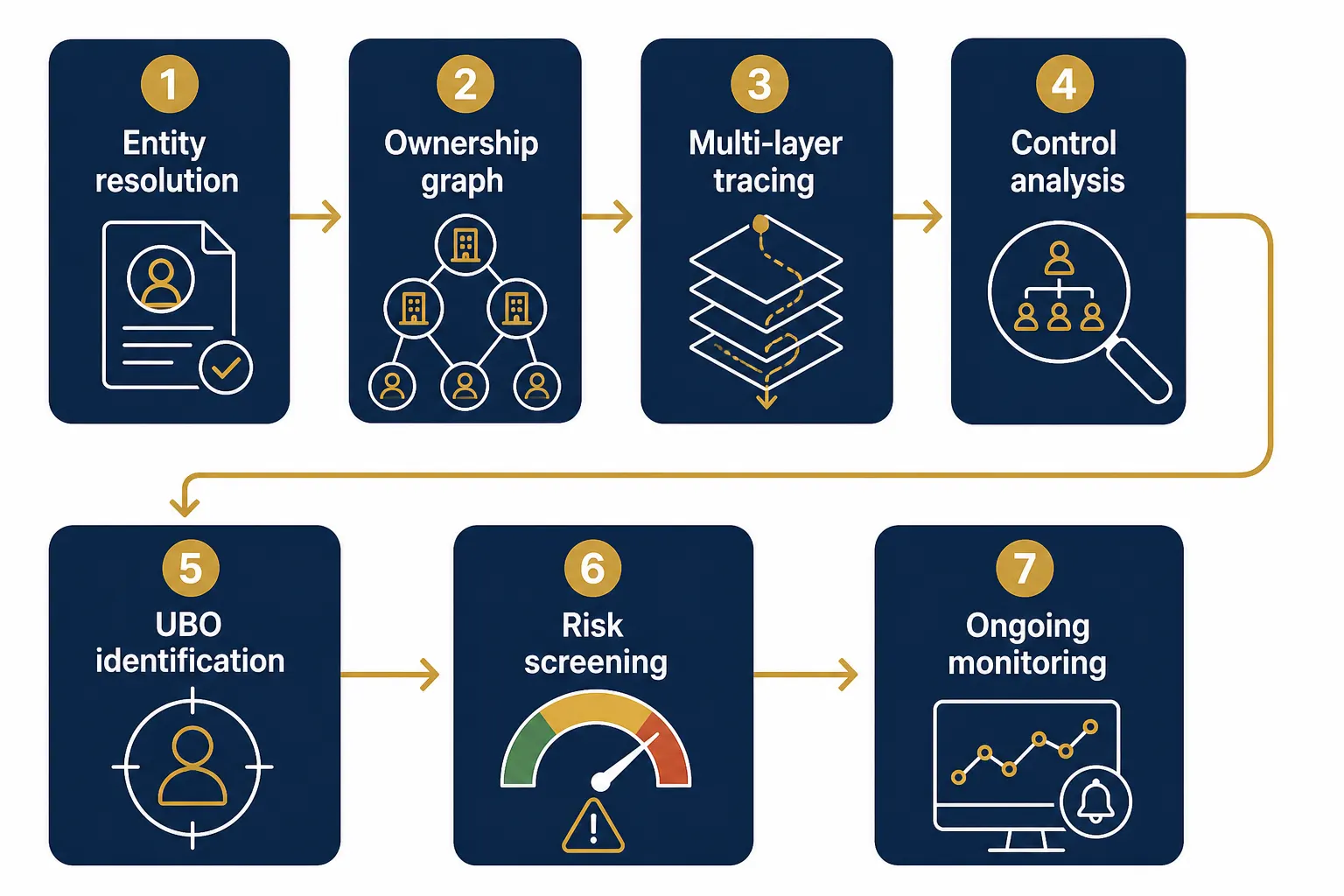
Step 1: Entity Resolution Across Systems
The first step is ensuring all entities are correctly identified across:
- Corporate registries
- Internal systems
- Commercial databases
This prevents fragmented or duplicated records.
Step 2: Ownership Graph Construction
Compliance systems build a visual and analytical map of ownership relationships.
This includes:
- Direct ownership links
- Indirect shareholding chains
- Control relationships
Step 3: Multi-Layer Ownership Tracing
Analysts trace ownership across every layer until reaching natural persons.
This involves:
- Calculating indirect ownership percentages
- Identifying controlling interests
- Mapping cross-border structures
Step 4: Control vs Ownership Analysis
Not all influence comes from shares.
Teams also evaluate:
- Voting rights
- Board control
- Contractual influence
- Management authority
Step 5: UBO Identification
Once the structure is fully mapped, individuals meeting regulatory thresholds (often 25% ownership or control) are identified as UBOs.
Step 6: Risk Enrichment and Screening
Identified UBOs are screened for:
- Sanctions exposure
- PEP status
- Adverse media
- Regulatory enforcement actions
See ClearDil’s AML screening portal guide for how screening fits the workflow.
Step 7: Ongoing Monitoring
Ownership structures are dynamic. Monitoring ensures:
- Changes in shareholders are detected
- New layers are identified
- Risk profiles remain current
Ongoing due diligence (ODD) keeps ownership and risk signals current after onboarding. For payment-heavy KYB flows, see UBO discovery for fintech and payment providers.
Manual vs Automated Ownership Structure Analysis
| Factor | Manual Approach | Automated Approach |
|---|---|---|
| Speed | Slow, investigative | Real-time mapping |
| Scalability | Limited | High-volume capable |
| Accuracy | Human-dependent | Data-driven consistency |
| Visibility | Fragmented | Full ownership graph |
| Monitoring | Periodic | Continuous |
Manual analysis cannot keep up with modern global corporate complexity.
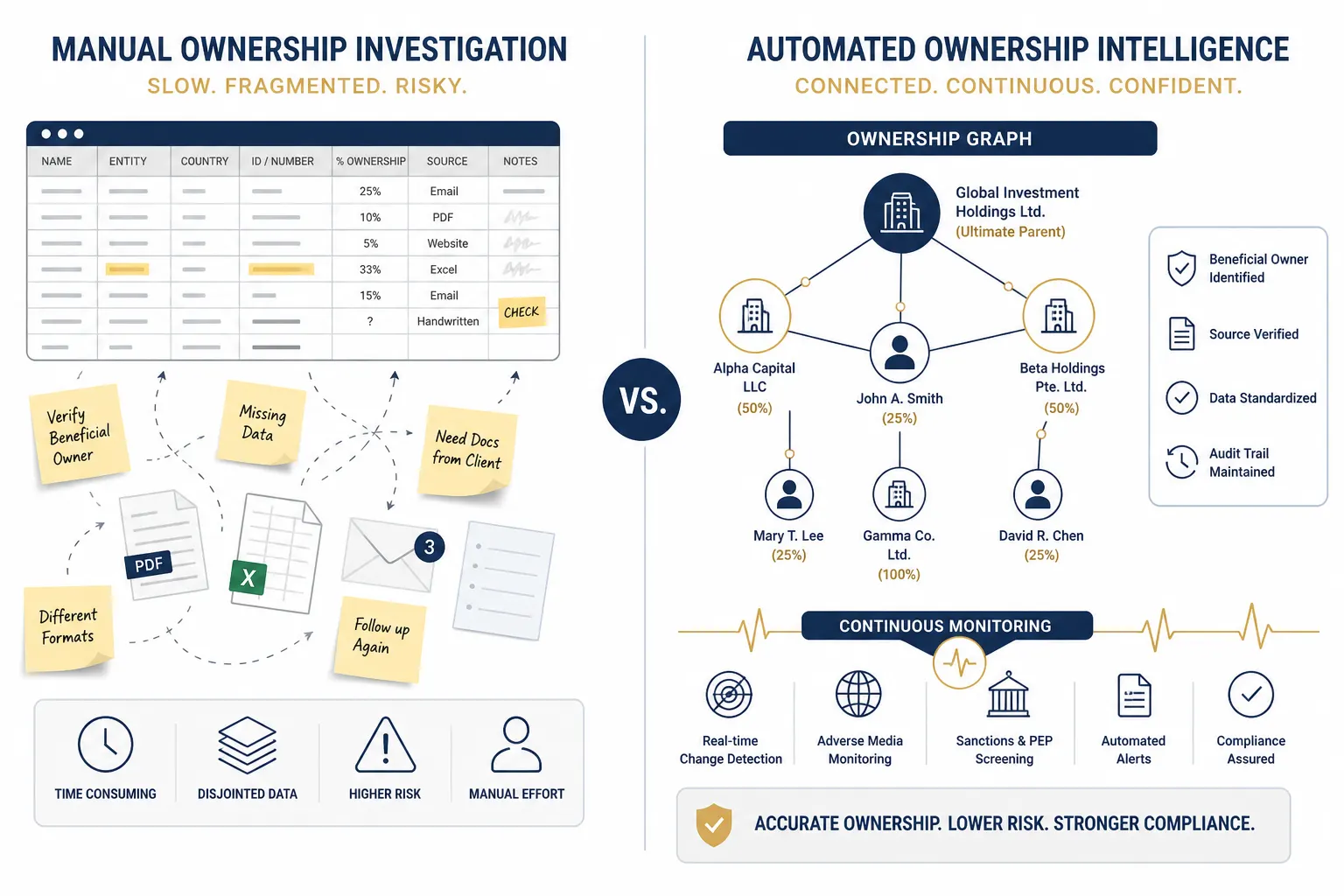
Why Ownership Structure Mapping Is a Data Problem
The core challenge is not intelligence gathering—it is relationship reconstruction across fragmented data sources.
Key technical challenges include:
- Inconsistent company naming conventions
- Missing cross-border registry data
- Lack of standardized ownership records
- Disconnected jurisdictional systems
- Hidden indirect relationships
This is why automation, entity resolution, and data aggregation are essential for credible KYB and business onboarding.
Industries Most Affected by Complex Ownership Structures
Financial Institutions
Banks must ensure full KYB transparency before onboarding corporate clients. See AML compliance software for financial institutions.
Fintech and Payments
High-volume onboarding requires fast but accurate ownership analysis.
Crypto and Digital Assets
Global, pseudonymous, and decentralized structures increase complexity.
Private Equity and Investment Firms
Multi-layer fund structures require deep ownership tracing.
Insurance and Lending
Risk-based underwriting depends on understanding ownership exposure. Pair ownership mapping with a risk-based AML approach.
Regulatory Expectations
Global regulators such as FATF and regional AML authorities require:
- Transparent beneficial ownership identification
- Accurate and up-to-date ownership records
- Ability to trace ownership to natural persons
- Ongoing monitoring of structural changes
Regulatory focus is increasingly shifting toward ownership transparency as a core AML control.
How Technology Solves Complex Ownership Structures
1. Global Data Aggregation
Combines data from:
- Corporate registries
- Ownership databases
- Regulatory filings
2. Entity Resolution Systems
Ensures consistent identification of entities across jurisdictions.
3. Ownership Graph Intelligence
Builds dynamic visual maps of ownership relationships.
4. AI-Assisted Pattern Recognition
Detects:
- Hidden ownership chains
- Unusual control structures
- Risk anomalies
5. Continuous Monitoring
Tracks structural changes in real time.
Best Practices for Managing Complex Ownership Risk
Use a Risk-Based Approach
Apply deeper analysis to:
- Offshore structures
- High-risk jurisdictions
- Multi-layer entities
Standardize Ownership Mapping
Ensure consistent representation of:
- Entity relationships
- Ownership percentages
- Control indicators
Automate Where Possible
Manual mapping does not scale in modern compliance environments.
Combine Ownership and Screening
UBO discovery should always be linked with:
- AML screening
- Sanctions checks
- PEP monitoring
Maintain Full Audit Trails
Document:
- Data sources used
- Ownership decisions
- Risk assessments
Developer-facing APIs and portal flows are documented at docs.cleardil.com.
The Future of Ownership Transparency
The future of AML compliance is moving toward:
- Global beneficial ownership registries
- Real-time ownership graphs
- AI-driven entity intelligence
- Automated risk scoring based on structure complexity
- Cross-border regulatory data sharing
Organizations that modernize early will have a major advantage in compliance efficiency and fraud prevention. For stack-level design, see AML for fintech compliance stack.
Conclusion
Complex ownership structures are one of the biggest challenges in modern AML and KYB compliance. As businesses expand globally and corporate arrangements become more layered, visibility into true ownership becomes harder—but also more important.
Organizations that rely on automation, structured ownership structure mapping, and continuous monitoring can uncover hidden beneficial owners, reduce compliance risk, and stay ahead of regulatory expectations.
In today’s environment, ownership transparency is not optional—it is a foundational requirement for financial integrity.
Frequently Asked Questions
What is a complex ownership structure?
It is a corporate setup where ownership is distributed across multiple entities, jurisdictions, or legal arrangements, making it difficult to identify the ultimate owner.
Why are complex ownership structures used?
They are used for legitimate business reasons like tax efficiency and investment structuring, but can also be used to obscure ownership.
Why are complex ownership structures risky?
They can hide beneficial owners, increase fraud risk, and make regulatory compliance more difficult.
How do companies analyze ownership structures?
They use entity resolution, ownership graph mapping, and multi-layer tracing to identify UBOs.
Can manual processes handle complex ownership structures?
No. Manual processes cannot scale or reliably trace deeply layered global ownership networks.