
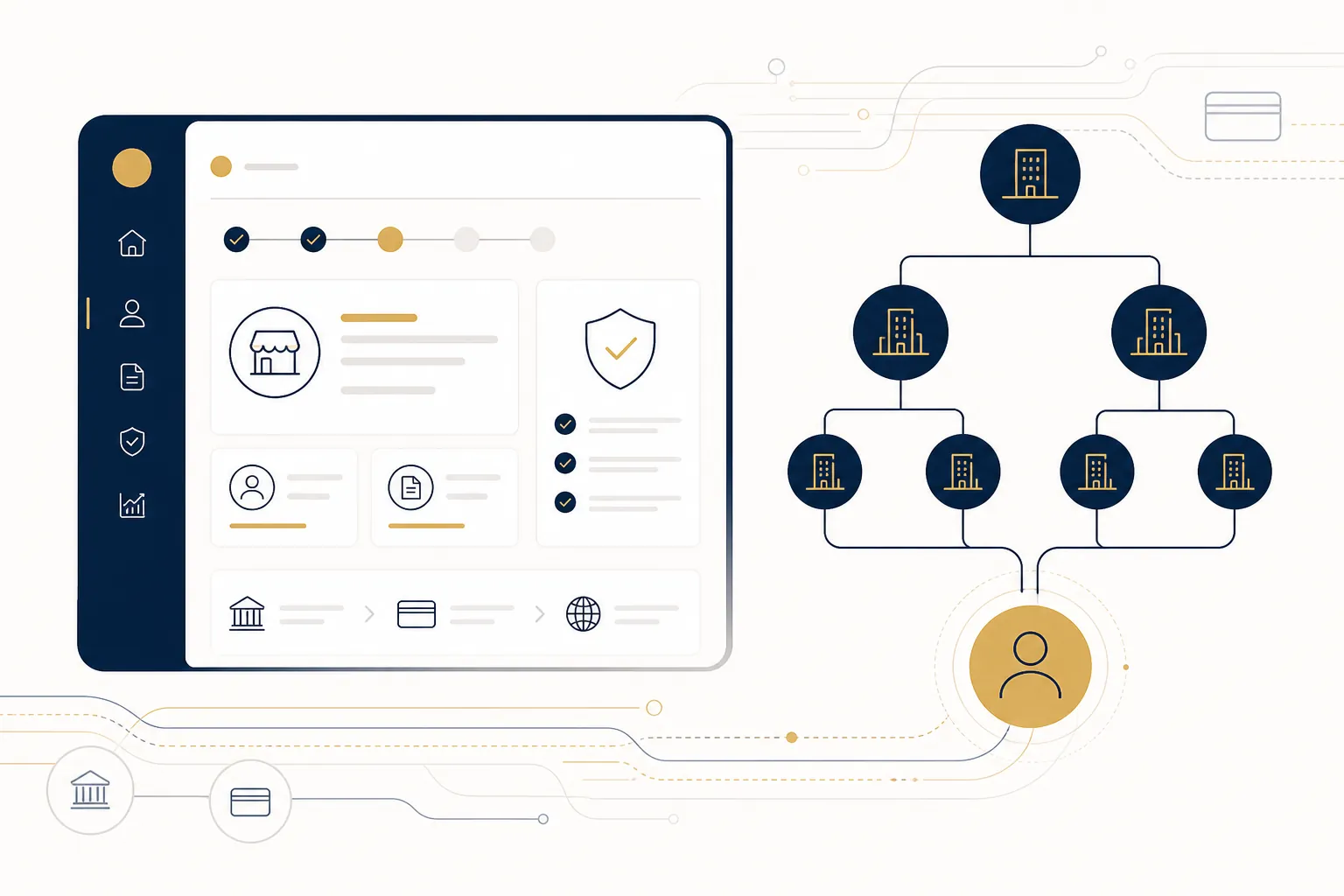
Fintech companies, payment service providers (PSPs), digital banks, and crypto platforms operate in one of the highest-risk compliance environments. They onboard merchants quickly, process large transaction volumes, and often serve cross-border businesses with complex ownership structures.
That speed creates a core KYB problem: accurate UBO (Ultimate Beneficial Owner) discovery at scale.
Fraudsters and high-risk entities exploit onboarding gaps by hiding behind layered corporates, offshore entities, and nominee arrangements. Without robust UBO discovery, payment platforms risk onboarding sanctioned parties, shell companies, or fraudulent merchants. That is why UBO discovery is now a pillar of fintech KYB and AML programs for payment service providers.
Quick Answer: What Is UBO Discovery in Fintech?
UBO discovery in fintech is the process of identifying the real individuals who own or control merchants by analyzing ownership structures, corporate data, and regulatory sources. It traces ownership across jurisdictions, validates corporate relationships, and detects hidden or indirect control that may not appear in a merchant’s onboarding declaration.
For the identification mechanics, see UBO identification explained. For why spreadsheet-and-registry hunts fail at volume, see why manual beneficial ownership checks no longer scale.
Why UBO Discovery Is Critical for Payment Providers
Fintech and payment companies face different pressures than traditional banks: conversion-first onboarding, global merchant books, and acquiring-bank scrutiny. UBO discovery is how they close the ownership blind spots those conditions create.
1. High-Speed Onboarding Pressure
Fintech platforms prioritize seamless onboarding and conversion. Speed can conflict with deep ownership analysis, leaving gaps where risky entities pass initial business onboarding checks.
2. Cross-Border Merchant Risk
Payment providers often serve global merchants operating across multiple jurisdictions, including:
- Offshore companies
- High-risk jurisdictions
- Complex international holding structures
Those patterns make ownership tracing harder and raise cross-border merchant risk.
3. Fraud and Shell Companies
Fraudsters frequently create:
- Shell companies
- Fake storefront businesses
- Layered corporate structures
These are designed to obscure beneficial ownership while still obtaining a payment account.
4. Regulatory Scrutiny on PSPs
Regulators expect fintech companies to apply strong KYB controls, including:
- UBO identification
- Beneficial ownership verification
- AML screening
- Continuous monitoring
Failure can mean fines, licensing issues, or acquiring-bank restrictions. AML compliance software for financial institutions is how many programs operationalize those controls.
How UBO Discovery Works in Fintech Environments
Modern fintech UBO discovery is a structured, multi-layer process designed to run at merchant-onboarding volume.
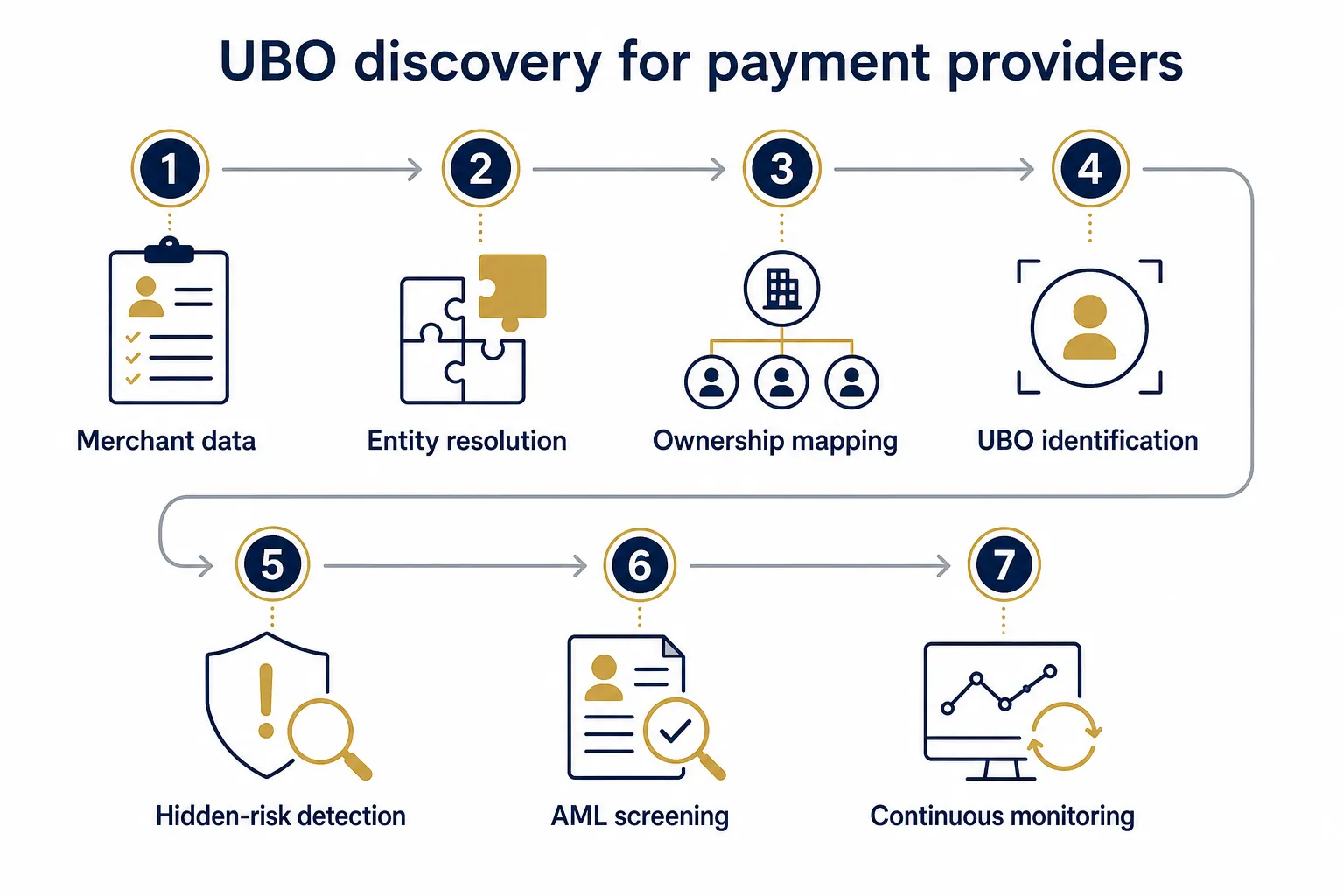
Step 1: Merchant Onboarding Data Collection
The process begins when a merchant applies for a payment account. Collected data typically includes:
- Legal business name
- Registration details
- Business model
- Ownership declarations
- Country of incorporation
Step 2: Automated Entity Resolution
Systems normalize and match business identities across global databases so the same company is not treated as two records.
This prevents issues such as:
- Duplicate entities
- Mismatched company records
- Inconsistent naming conventions
Step 3: Ownership Structure Mapping
The system builds a full ownership graph that includes:
- Parent companies
- Subsidiaries
- Holding structures
- Cross-border ownership links
This step is critical for uncovering indirect ownership.
Step 4: UBO Identification
UBOs are identified based on:
- Direct ownership thresholds (for example, 25%+)
- Indirect ownership through layered entities
- Control-based definitions (voting rights, decision authority)
UBO identification and verification platforms automate this step while keeping investigators in control of risk decisions.
Step 5: Hidden Ownership Risk Detection
Fintech platforms must detect risks such as:
- Nominee shareholders
- Offshore intermediaries
- Shell companies with no real operations
- Circular ownership structures
This step is essential for fraud prevention.
Step 6: AML and Risk Screening
Once UBOs are identified, they are screened for:
- Sanctions exposure
- Politically Exposed Person (PEP) status
- Adverse media
- Financial crime associations
Integrating AML screening at this stage connects ownership intelligence to watchlist controls.
Step 7: Continuous Monitoring
Ownership structures can change after onboarding. Fintech platforms must monitor:
- Merchant ownership changes
- New shareholders
- Corporate restructuring
- Risk profile changes
Ongoing due diligence keeps the ownership graph current through the merchant lifecycle.
Common UBO Risks in Fintech
Layered Offshore Structures
Many high-risk merchants use offshore jurisdictions to obscure ownership.
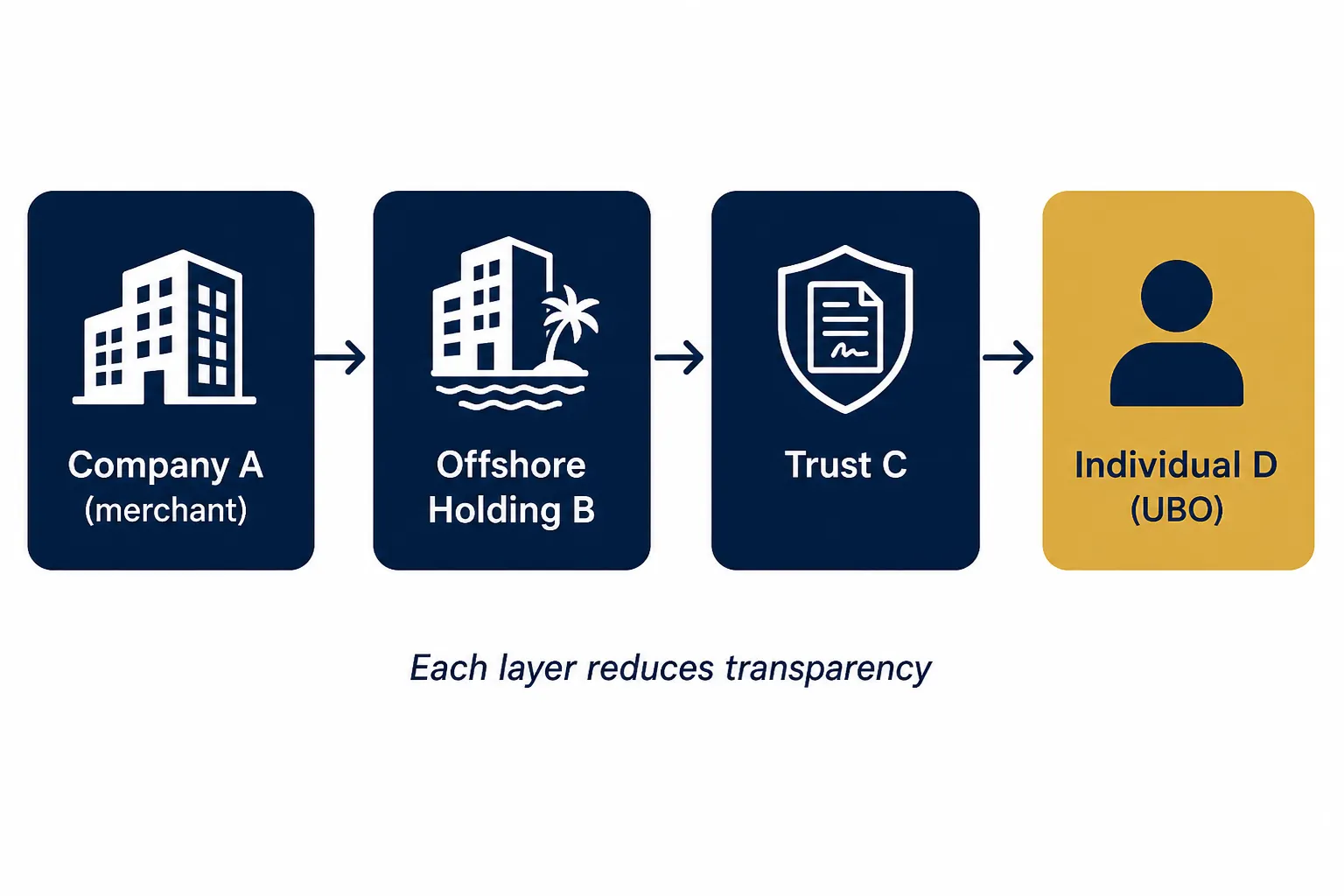
Example structure:
Company A → Offshore Holding B → Trust C → Individual D
Each layer reduces transparency and increases risk.
Fake or Dormant Entities
Some fraud schemes involve companies that:
- Exist only on paper
- Have no operational activity
- Are used purely for payment processing abuse
Rapid Ownership Changes
High-risk merchants may frequently change ownership to avoid detection or regulatory tracking.
Hidden Control Structures
Even when shareholding appears compliant, control may still lie with undisclosed individuals through:
- Voting agreements
- Shadow directors
- Proxy arrangements
Manual vs Automated UBO Discovery in Fintech
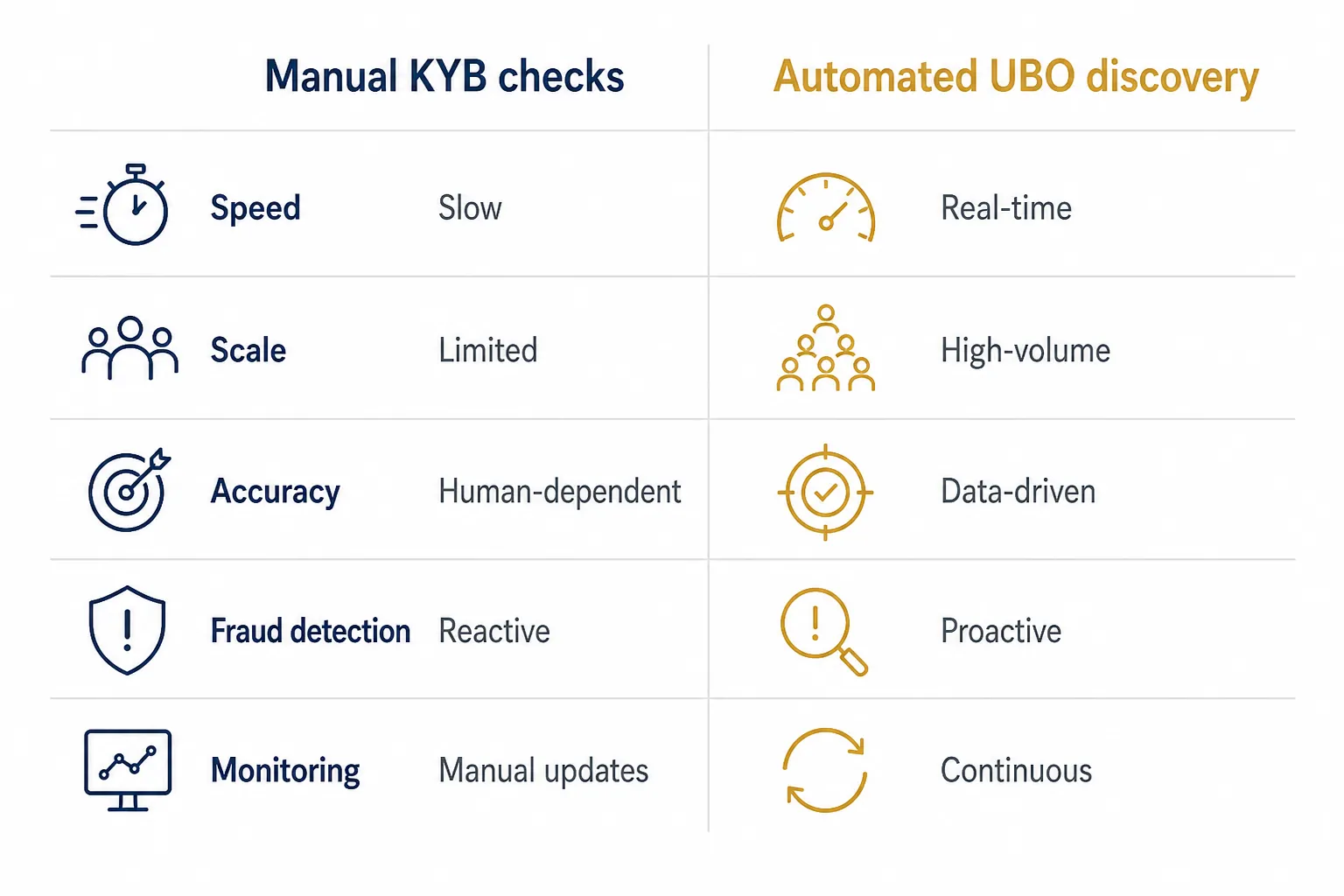
| Factor | Manual KYB Checks | Automated UBO Discovery |
|---|---|---|
| Speed | Slow onboarding | Real-time processing |
| Scale | Limited | High-volume capable |
| Accuracy | Human-dependent | Data-driven consistency |
| Fraud Detection | Reactive | Proactive risk detection |
| Monitoring | Manual updates | Continuous tracking |
Fintech companies cannot rely on manual processes given onboarding speed requirements. That is the same constraint described in beneficial ownership tracing: why manual checks fail.
Why Fintech Needs Real-Time UBO Intelligence
Payment providers operate in environments where:
- Fraud occurs within minutes
- Merchants onboard globally
- Transaction volumes scale rapidly
Real-time ownership intelligence helps detect:
- Suspicious ownership patterns instantly
- High-risk jurisdiction exposure
- Sudden changes in control structures
That enables proactive risk mitigation rather than reactive compliance. Pair it with a risk-based AML approach so deeper investigation is reserved for higher-risk merchants.
Regulatory Expectations for Fintech UBO Discovery
Fintech companies are expected to comply with global AML frameworks including:
- FATF recommendations on beneficial ownership transparency
- EU AML directives for financial institutions
- National PSP licensing requirements
- Bank partner compliance expectations
In many cases, acquiring banks require fintechs to demonstrate strong UBO controls before approval. See the global UBO identification and verification requirements guide for how thresholds and registries differ by market.
How Technology Improves Fintech UBO Discovery
Modern fintech compliance stacks use automation to scale UBO discovery.
1. Global Data Aggregation
Combines data from:
- Corporate registries
- Ownership databases
- Regulatory filings
- Commercial intelligence sources
2. AI-Powered Ownership Mapping
AI helps identify:
- Indirect ownership chains
- Complex corporate structures
- Hidden relationships across entities
3. Entity Resolution Systems
Ensures consistent identification of companies and individuals across systems.
4. Risk Scoring Models
Automated systems assign risk scores based on:
- Ownership complexity
- Jurisdiction risk
- UBO profiles
- Historical behavior
5. Continuous Monitoring
Detects changes in ownership or risk exposure in real time.
Developer teams can wire the same controls into onboarding via the ClearDil API documentation.
Best Practices for Fintech UBO Discovery
Integrate UBO Checks Into Onboarding
UBO discovery should be part of instant KYB workflows, not a post-go-live research ticket.
Use Risk-Based Thresholds
Apply deeper investigation for:
- High-risk industries
- Cross-border merchants
- Complex ownership structures
Automate Ownership Mapping
Manual mapping cannot scale with fintech growth.
Monitor Continuously
Ownership changes must trigger automated re-evaluation.
Combine UBO With AML Screening
UBO discovery should be linked directly to:
- Sanctions screening
- PEP checks
- Adverse media monitoring
The Future of UBO Discovery in Fintech
The future is moving toward:
- Fully automated KYB pipelines
- Real-time global ownership graphs
- AI-driven fraud detection models
- Regulatory-connected ownership registries
- Instant onboarding with embedded compliance
Fintech companies that adopt these systems early gain an advantage in speed, compliance, and risk reduction.
Conclusion
UBO discovery is a critical safeguard for fintech and payment providers operating in high-speed, high-risk environments. As fraud tactics become more sophisticated and regulatory expectations increase, manual compliance approaches are no longer sufficient.
Automation, real-time ownership intelligence, and continuous monitoring are now essential to maintaining compliance while enabling fast, frictionless merchant onboarding.
Fintech companies that invest in scalable UBO discovery can reduce risk, improve onboarding efficiency, and strengthen trust across their payment ecosystems.
Automated UBO Discovery for Payment Providers
Frequently Asked Questions
What is UBO discovery in fintech?
It is the process of identifying the real individuals who own or control merchants or business customers using ownership analysis and corporate data.
Why is UBO discovery important for payment providers?
It helps prevent fraud, meet AML obligations, and avoid onboarding high-risk or sanctioned entities.
How do fintech companies detect hidden ownership?
They use automated systems to map ownership structures, analyze indirect control, and screen for risk indicators.
What are common UBO risks in fintech?
Shell companies, offshore structures, nominee shareholders, and rapidly changing ownership structures.
Can manual UBO checks work for fintech?
No. Manual checks do not scale with the speed and volume of fintech onboarding.