

Ultimate Beneficial Owner (UBO) identification and verification requirements are a cornerstone of global Anti-Money Laundering (AML) and Know Your Business (KYB) regulation. They require regulated organizations to look beyond a company’s legal name and determine which natural persons ultimately own or control it.
Financial institutions, fintech companies, payment providers, insurers, and other regulated businesses use this information to assess risk, prevent financial crime, and demonstrate effective customer due diligence. As ownership chains become more complex and cross-border, reliable beneficial ownership data is increasingly important.
Quick Answer: What Are UBO Identification and Verification Requirements?
UBO identification and verification requirements are global AML obligations requiring organizations to identify the individuals who ultimately own or control a legal entity, verify their identity and ownership using reliable data and documented evidence, and keep that information accurate over time.
Identification answers who owns or controls the entity. Verification tests whether the identity and ownership information is genuine, accurate, and supported by independent sources.
Why UBO Requirements Matter
Legal entities can be misused to hide the people directing or benefiting from illicit activity. Shell companies, nominee arrangements, trusts, and layered holding structures may obscure a person’s connection to a business.
Effective UBO identification and verification helps organizations:
- Understand the natural persons behind a customer
- Detect hidden ownership and control risks
- Apply appropriate customer due diligence
- Screen relevant individuals for sanctions, PEP, and adverse media exposure
- Maintain evidence for audits and regulatory reviews
- Support corporate ownership transparency
These controls should sit inside a broader KYB and business onboarding process rather than operate as a one-time, isolated check.
Global Regulatory Framework for UBO Compliance
There is no single global beneficial ownership law. The Financial Action Task Force (FATF) sets international standards, while each jurisdiction translates those standards into local laws, thresholds, reporting rules, and access arrangements.
FATF Recommendation 24
FATF Recommendation 24 is the primary global standard for transparency and beneficial ownership of legal persons. It calls for countries to ensure that competent authorities can obtain adequate, accurate, and up-to-date beneficial ownership information efficiently.
For compliance teams, FATF-aligned controls generally mean:
- Identifying the natural persons who ultimately own or control a legal entity
- Assessing ownership and control through multiple entity layers
- Using reliable sources to verify the result
- Keeping beneficial ownership information current
- Applying stronger measures where risk is higher
FATF guidance is a global benchmark, but businesses must still follow the specific laws and regulatory guidance that apply in each jurisdiction.
European Union AML Framework
The European Union’s AML framework requires obliged entities to identify beneficial owners and take reasonable measures to verify their identity during customer due diligence. A holding of more than 25% is generally an indication of ownership under the framework, but ownership is not the only test: control through other means must also be considered.
The EU’s 2024 AML package strengthens common rules for beneficial ownership information and central registers. Access is not simply unrestricted public access. Competent authorities and obliged entities receive access for AML purposes, while other users may need to demonstrate a legitimate interest under national implementation.
Organizations operating in the EU should account for:
- Direct and indirect ownership
- Control through other means
- National registry and discrepancy-reporting requirements
- Enhanced due diligence for higher-risk relationships
- Evolving implementation of the EU AML Regulation and sixth AML Directive
United Kingdom PSC Regime
The United Kingdom requires companies and certain other entities to identify and report People with Significant Control (PSCs). A person may qualify by holding more than 25% of shares or voting rights, having rights to appoint or remove a majority of directors, or otherwise exercising significant influence or control.
Companies must investigate their ownership, maintain the required records, and update Companies House when reportable information changes. Regulated firms must separately meet their own AML customer due diligence obligations; a registry entry should not be treated as sufficient verification on its own.
United States Corporate Transparency Act
The U.S. Corporate Transparency Act (CTA) framework changed materially in 2025. Under FinCEN’s March 2025 interim final rule, entities created in the United States and U.S. persons are exempt from federal beneficial ownership information reporting. The reporting rule currently applies only to certain foreign entities registered to do business in a U.S. jurisdiction, subject to exemptions, and those entities do not report U.S. persons as beneficial owners.
This federal reporting position does not eliminate other U.S. customer due diligence, sanctions, state-law, or sector-specific obligations. Organizations should check current FinCEN beneficial ownership guidance rather than relying on older CTA summaries.
Other Global Jurisdictions
Jurisdictions including Singapore, Canada, Australia, and financial centers in the Middle East maintain their own beneficial ownership and AML frameworks. Their definitions, filing requirements, registry access, and ownership thresholds differ.
The consistent direction is toward better access to accurate ownership information. A global program therefore needs a common control framework with jurisdiction-specific rules layered on top.
UBO Identification Requirements
UBO identification determines which natural persons meet the applicable ownership or control definition. For a straightforward company, this may involve one shareholder register. For a multinational group, it can require tracing several layers across multiple jurisdictions.
Core Identification Controls
Organizations should:
- Collect legal entity, registration, and ownership information
- Map direct and indirect ownership through each entity layer
- Calculate each natural person’s effective ownership
- Identify voting, appointment, veto, and other control rights
- Assess trusts, partnerships, nominees, and intermediate holding companies
- Record the rule and threshold used for each determination
- Escalate cases where no natural person is identified under the ownership test
For a deeper explanation of ownership tracing, see how UBO identification works.
Ownership Thresholds Are a Starting Point
A 25% threshold is common, but it is not universal and should not be used as the only test. Some regimes use “more than 25%,” others use “25% or more,” and lower thresholds may apply in specific sectors or higher-risk cases.
Control can also establish beneficial ownership without a qualifying shareholding. Compliance teams should examine voting agreements, appointment rights, dominant influence, and other arrangements that allow an individual to direct the entity.
Calculating Indirect Ownership
Indirect ownership is usually calculated by multiplying ownership percentages along a chain.
If an individual owns 60% of Holding Company A, and Holding Company A owns 50% of Customer B, the individual’s effective ownership in Customer B is:
60% × 50% = 30%
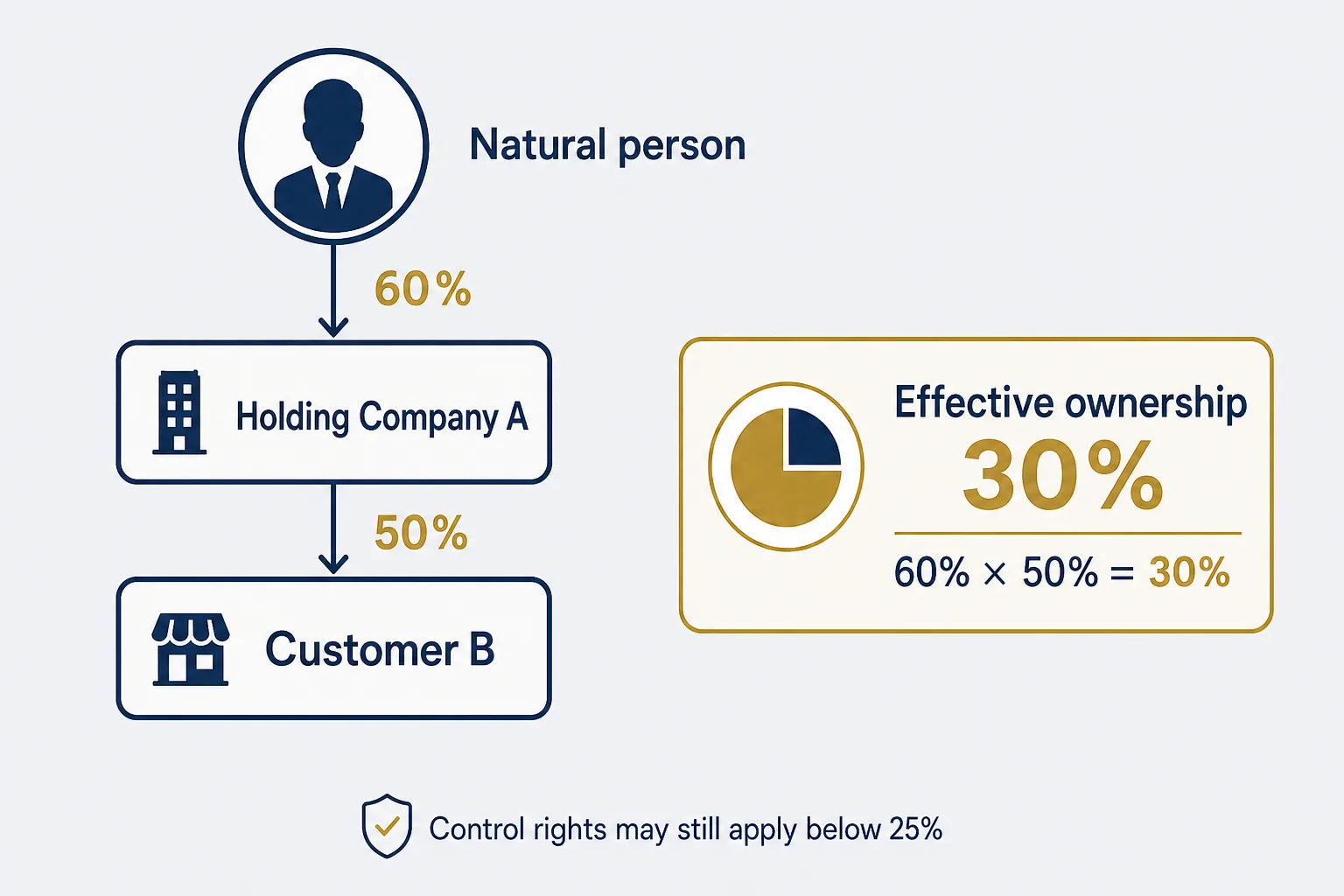
That result must then be assessed against the applicable jurisdiction’s definition and control tests.
UBO Verification Requirements
Verification establishes that the identified owners are real people and that the ownership or control analysis is supported by credible evidence. A customer declaration can start the process, but it should be tested against reliable, independent sources according to risk.
Identity Verification
For each identified beneficial owner, organizations may need to verify:
- Full legal name
- Date and place of birth
- Nationality and residence
- Government-issued identity document
- Address or other required identifying information
The exact data depends on local law and the organization’s risk-based policy.
Ownership and Control Verification
Ownership claims can be checked against:
- Official corporate registries
- Shareholder and member registers
- Articles of association and incorporation documents
- Annual reports and regulatory filings
- Trust deeds or partnership agreements
- Audited records and independent ownership data
Beneficial ownership verification should document both the source and the reasoning used to reach the conclusion.
AML Risk Screening
After identification and verification, relevant entities and individuals should be checked under the organization’s AML policy. This may include sanctions, PEP, watchlist, and adverse media checks.
ClearDil’s AML screening documentation explains how screening scopes can be applied to customers. A match is not automatically proof of risk; it requires contextual review and resolution.
Step-by-Step Global UBO Compliance Process
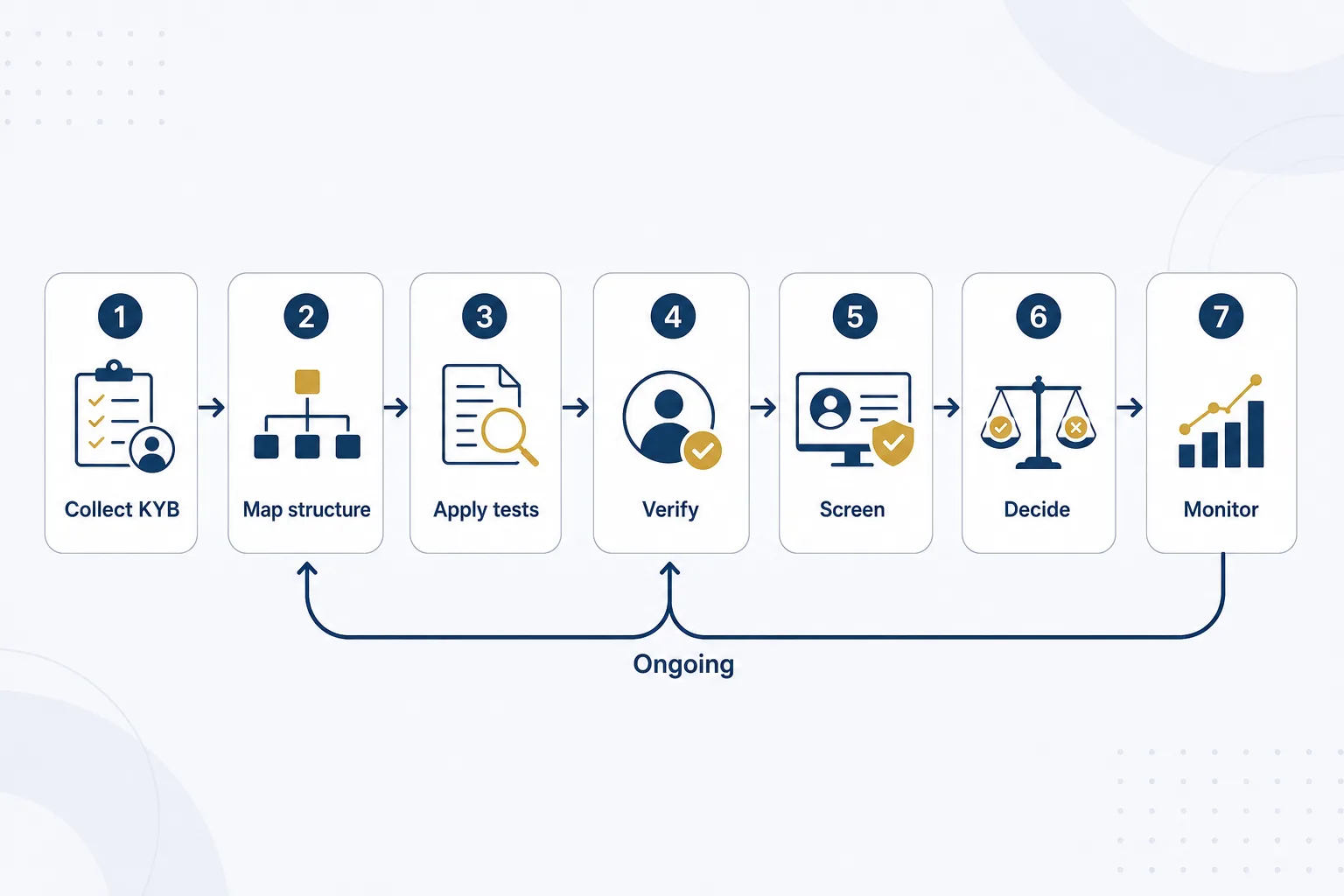
Step 1: Collect KYB Information
Gather the entity’s legal name, registration number, jurisdiction, legal form, directors, shareholders, and relevant corporate documents. Capture the customer’s ownership declaration and the purpose of the business relationship.
Step 2: Map the Ownership Structure
Create a complete ownership chart covering parent companies, subsidiaries, holding companies, trusts, partnerships, and cross-border entities. Continue tracing until natural persons are reached or the applicable control rule determines the outcome.
Step 3: Apply Ownership and Control Tests
Calculate direct and indirect percentages. Then assess voting power, appointment rights, contractual influence, and any other means of control. Record which legal or policy test applies.
Step 4: Verify Identity and Ownership
Validate each UBO’s identity and compare ownership claims with reliable, independent records. Investigate discrepancies rather than accepting whichever source is easiest to obtain.
Step 5: Screen and Risk-Rate
Screen the entity, UBOs, directors, and other relevant connected parties according to policy. Combine those results with geography, industry, product, and ownership-complexity risk factors.
Step 6: Decide and Document
Approve, reject, or escalate the relationship based on the evidence and risk assessment. Preserve source records, calculations, discrepancy decisions, and reviewer actions in an audit trail.
Step 7: Monitor for Change
Beneficial ownership can change after onboarding. Trigger reviews when shareholdings, directors, control rights, registry records, or customer risk change. Ongoing due diligence helps keep screening and customer records current through the lifecycle.
Common Challenges in Global UBO Compliance
Fragmented Rules
Thresholds, legal definitions, filing duties, and registry access vary by country. A global policy must distinguish the organization’s own due diligence obligation from the customer’s separate obligation to report to a government register.
Complex Ownership Structures
Cross-holdings, trusts, nominees, offshore companies, and shell entities can make ownership paths difficult to resolve. Calculations also become error-prone when one person holds interests through several branches of the same structure.
Incomplete or Conflicting Data
Registries may be delayed, restricted, self-reported, or unavailable. Customer documents and commercial databases may disagree. A sound process preserves discrepancies, evaluates source reliability, and escalates unresolved cases.
Control Without Ownership
Threshold-only workflows can miss individuals who exercise control through agreements, voting arrangements, appointment rights, or informal influence. Ownership and control must be assessed together.
Stale Information
A verified ownership chart represents a point in time. Without event-driven or periodic review, reorganizations and share transfers can quickly make it inaccurate.
Technology’s Role in Meeting UBO Requirements
Automation can improve consistency and speed, especially when onboarding volumes or ownership structures are complex.
Modern UBO identification and verification software can support:
- Registry and corporate data aggregation
- Entity resolution across inconsistent names and identifiers
- Multi-layer ownership mapping
- Indirect ownership calculations
- Identity and document verification
- Sanctions, PEP, and adverse media screening
- Change detection and ongoing monitoring
- Audit-ready evidence and decision records
Technology does not replace legal interpretation or accountable compliance decisions. It should make the evidence, calculations, rules, and exceptions easier for reviewers to understand and test.
Best Practices for a Global UBO Program
Use a Risk-Based Framework
Define baseline checks, then increase evidence and review for high-risk jurisdictions, opaque structures, nominee arrangements, unusual control rights, or conflicting data. A documented risk-based AML approach helps teams allocate scrutiny consistently.
Maintain a Jurisdiction Rules Library
Track definitions, thresholds, senior-managing-official fallback rules, reporting obligations, and evidence standards for the markets in which the organization operates. Assign owners and effective dates to regulatory changes.
Use Multiple Reliable Sources
Do not rely on a single registry or customer declaration. Compare official records, corporate documents, independent data, and verified identity evidence in proportion to risk.
Preserve Calculations and Audit Trails
Store the ownership chart, source records, percentage calculations, control analysis, screening outcomes, exceptions, and approval history. Reviewers should be able to reconstruct how the organization reached its decision.
Integrate UBO Controls Into KYB
Connect ownership analysis with entity verification, customer risk scoring, enhanced due diligence, case management, and lifecycle monitoring. An integrated workflow reduces handoffs and ensures ownership findings affect the onboarding decision.
Review Rules and Records Continuously
Monitor regulatory changes and refresh ownership information when risk events occur. Static annual reviews alone may not capture material changes quickly enough for higher-risk relationships.
Conclusion
UBO identification and verification requirements share a common objective: regulated organizations must understand who ultimately owns or controls a customer and support that conclusion with reliable evidence.
The practical details vary by jurisdiction. Strong programs combine a current rules library, complete ownership mapping, independent verification, risk screening, documented decisions, and ongoing monitoring. Automation can make those controls more scalable while preserving human oversight for complex or high-risk cases.
Automate Global UBO Compliance with ClearDil
Frequently Asked Questions
What are UBO identification requirements?
They are regulatory obligations requiring organizations to identify the natural persons who ultimately own or control a legal entity through direct ownership, indirect ownership, or other means of control.
What are UBO verification requirements?
They require organizations to validate a UBO’s identity and ownership or control information using reliable, independent data and documented evidence appropriate to the risk.
What is the global standard for UBO compliance?
FATF Recommendations, especially Recommendation 24 for legal persons, are the global benchmark, but organizations must apply the specific laws and regulatory guidance of each relevant jurisdiction.
What is the ownership threshold for a UBO?
Many jurisdictions use a threshold around 25%, but the exact rule varies, and a person may qualify through control even without meeting an ownership threshold.
Why is UBO compliance important?
It helps organizations identify the people behind legal entities, meet AML and KYB obligations, detect hidden financial crime risk, and improve corporate transparency.