
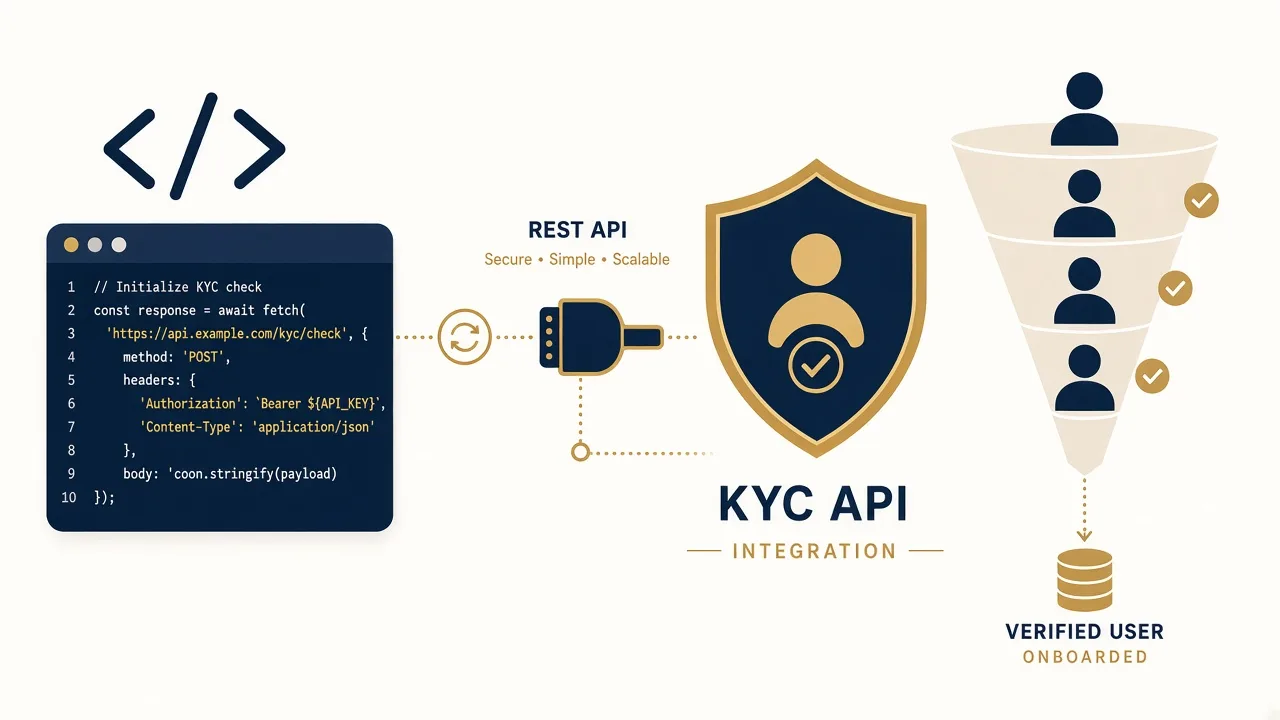
Quick Answer: KYC API integration is the process of embedding identity verification, document checks, and AML screening into your product via REST endpoints and webhooks—so customer onboarding stays fast, consistent, and audit-ready without building verification infrastructure from scratch.
Why KYC API Integration Is a Product Problem (Not Only a Compliance One)
KYC onboarding is where conversion and control share the same screen.
If engineering treats KYC API integration as a side ticket—and compliance treats it as a policy document—you get a brittle glue layer: polling that times out, statuses nobody maps to UX, and investigators opening cases with missing evidence.
A clean API for KYC verification integration keeps one customer identity across create, verify, screen, and review. Product ships faster. Compliance defends decisions. Support stops chasing “where did this applicant go?”
If you need the category baseline first, start with What is a KYC API?, then return here for implementation patterns.
Map the End-to-End Workflow First
Do not start with endpoint trivia. Start with the journey you will defend in an audit.
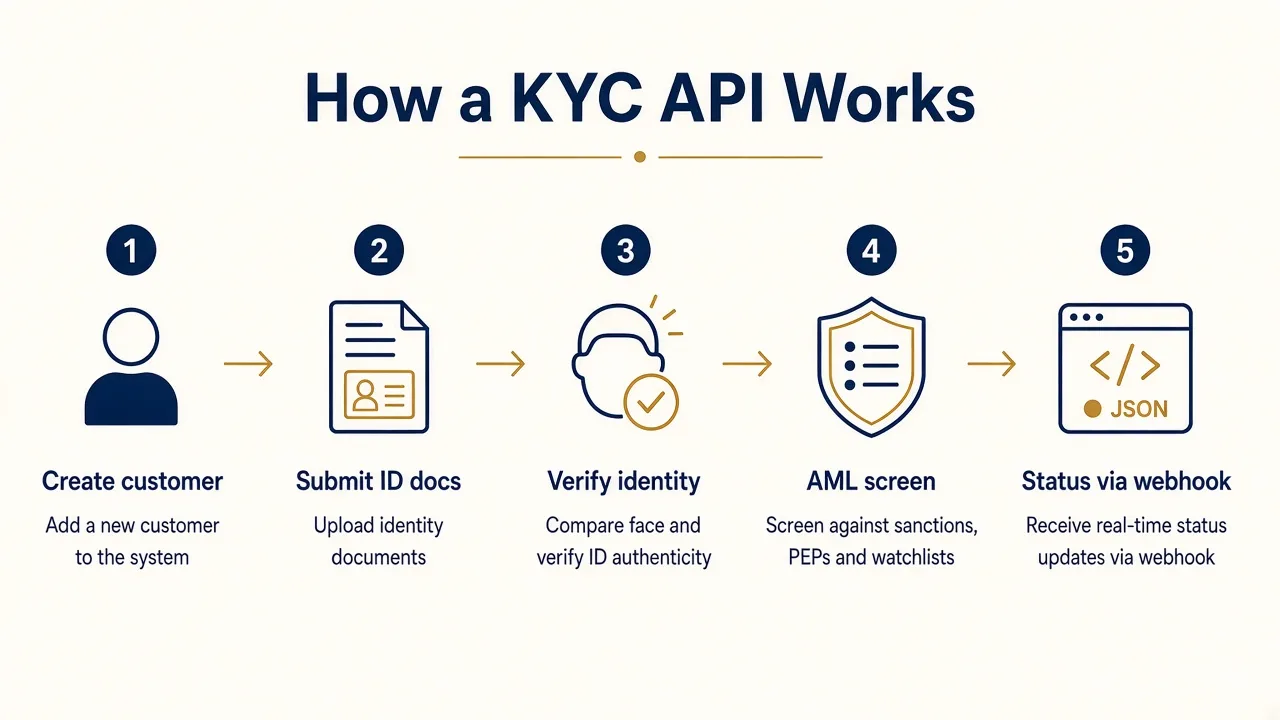
Agree across product, compliance, and engineering:
- Which applicant types (individuals, companies, both)
- Which documents and countries are in scope on day one
- When screening runs (before activation, before first transaction, both)
- Which statuses auto-approve vs force review
- Who owns exceptions and SLA clocks
- What evidence must be retained and for how long
Without that map, a REST API KYC build becomes a moving target—and every market expansion reopens the same debates.
REST Integration Steps That Ship Faster
Most customer onboarding API designs follow the same sequence. ClearDil’s docs walk the path from API introduction through creating a customer and screening.
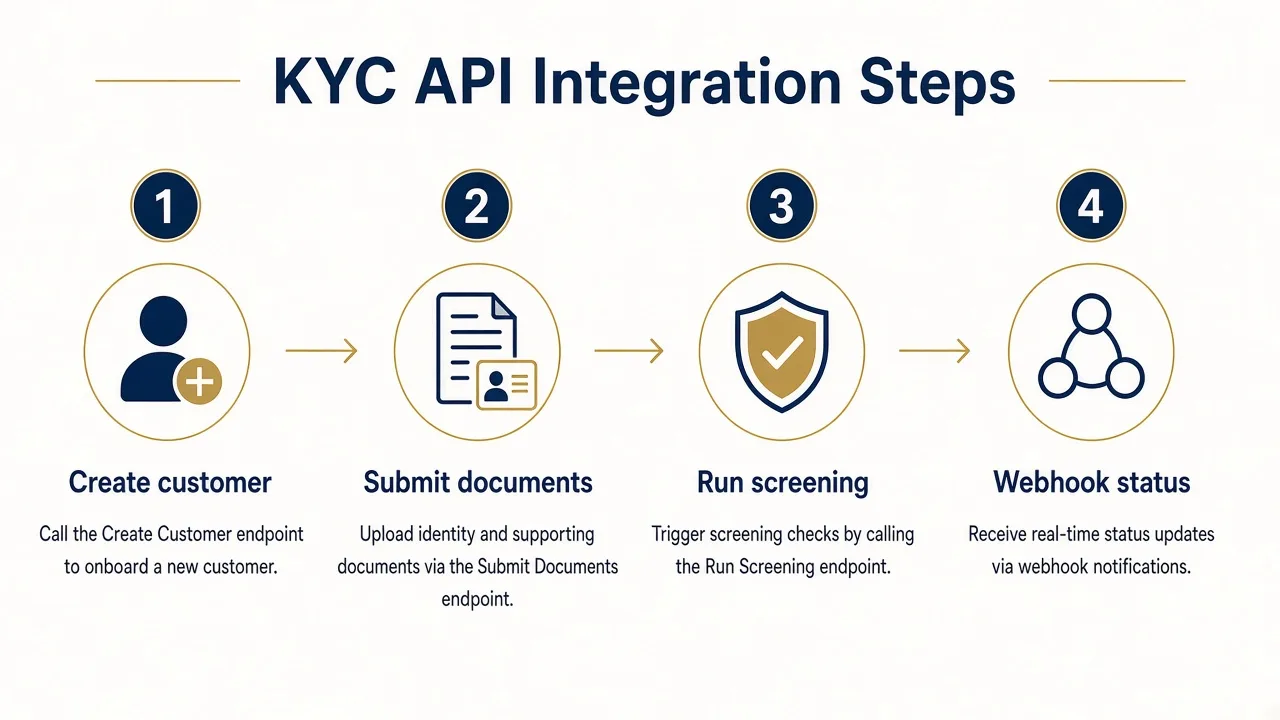
1. Authenticate and configure the environment
Use separate sandbox and production credentials. Confirm scopes, base URLs, and secrets handling before writing business logic. Read the API reference early—docs quality predicts integration cost.
2. Create the customer (or case)
Create a stable customer record first. Every later verification, document, and screening result should attach to that ID. Orphaned checks are how audits fail and support tickets multiply.
3. Trigger identity and document verification
Collect data in your UI or via a hosted verification flow link. Use document verification and identity verification guides to define required fields and failure UX.
4. Run AML screening
Trigger sanctions/PEP/adverse media screening against the same customer. Do not treat screening as a second vendor bolted on after go-live—see AML automation via APIs for why unified flows reduce investigator load.
5. Prefer webhooks; use polling as a fallback
Design webhook handlers that are idempotent, authenticated, and retry-safe. Poll only for recovery or UI “refresh” cases. Silent missed events create applicants stuck in limbo.
6. Route decisions and human review
Map provider statuses to your policy: approve, decline, or escalate. Give reviewers evidence packs via case tooling and risk profile review patterns—not screenshots in Slack.
7. Persist evidence and observability
Log request IDs, status transitions, and reviewer actions. Onboarding without observability is not “fast”—it is opaque.
Optional: accelerate front-end capture with the Web SDK when you want less custom UI work.
Best Practices for Faster Customer Onboarding
Keep one customer ID across every check
Fragmented IDs across IDV and screening tools force manual reconciliation. A single KYC integration identity is the cheapest reliability upgrade you can make.
Design UX for pending states
Real-time does not mean instantaneous for every check. Show clear “verification in progress” and “under review” states. Timeouts without messaging destroy conversion.
Separate policy from plumbing
Engineers own retries, auth, and schemas. Compliance owns risk rules and escalation criteria. Document both. When they blur, every edge case becomes a meeting.
Test edge cases in sandbox before production
Use the free sandbox on KYC API / pricing paths to exercise expired documents, name mismatches, partial submissions, webhook retries, and dual-national edge cases. Happy-path demos hide the bugs that hit week two.
Plan KYB early if you serve businesses
If SMEs or funds are in scope, business onboarding and UBO checks belong in the architecture—not as a sequel project. See also the fintech compliance stack pattern.
Measure what matters
Track time-to-decision, auto-approve rate, false-positive review load, and drop-off by verification step. “We integrated KYC” is not a metric.
Common Integration Mistakes
- Starting UI polish before status mapping is agreed
- Polling-only architectures with no webhook recovery
- Auto-approving without a review escape hatch
- Treating sandbox as optional
- Shipping IDV first and “adding AML later” with a second customer model
- Ignoring data residency and retention until legal asks at the eleventh hour
Each mistake adds days of rework after the first production incident.
Ownership Model That Keeps Delivery Moving
| Role | Owns | Does not own alone |
|---|---|---|
| Product | Journey, conversion, status UX | Risk policy thresholds |
| Engineering | Auth, endpoints, webhooks, observability | Final accept/decline rules |
| Compliance | Risk rules, review SLAs, audit evidence | REST implementation details |
| Support | Applicant communications | Changing screening logic ad hoc |
Shared RACI beats heroic last-minute fixes.
How ClearDil Supports KYC API Integration
ClearDil’s KYC API gives developers a REST surface for create → verify → screen → review, with sandbox credentials and docs under Getting started and the developer docs home.
Teams evaluating KYC software can prove the flow in sandbox, then promote the same patterns to production without rewriting the onboarding spine.
Conclusion
Strong KYC API integration is less about calling endpoints and more about owning the journey: one customer ID, clear statuses, reliable webhooks, and a review path humans can defend.
Treat the customer onboarding API as product infrastructure. Teams that do ship faster onboarding without trading away audit readiness.
Try the ClearDil KYC API
Frequently Asked Questions
How do you integrate a KYC API?
Authenticate, create a customer, collect identity/document data, run verification and AML screening, receive results via API or webhook, then approve, decline, or escalate to review—while storing evidence against one customer ID.
What is the typical REST flow for KYC API integration?
Most integrations follow create customer → verify identity/documents → screen for AML → webhook or poll for status → decisioning. Exact endpoints vary by provider; the sequence rarely does.
Should KYC use webhooks or polling?
Prefer webhooks for async completion and reliability. Keep limited polling for recovery and UI refresh. Polling-only designs tend to miss events and create stuck applicants.
How do you test KYC API integration in a sandbox?
Run happy paths and failures: expired docs, mismatched names, webhook retries, review routing, and multi-step abandon/resume. Confirm evidence appears in the case/review view your compliance team will use.
What slows down KYC API integration projects?
Unclear status mapping, late AML scope, missing webhook design, and unclear ownership between product and compliance. Technical auth issues are rarely the longest delay.
Can product and compliance share one KYC integration?
Yes—and they should. One integration with shared customer IDs, statuses, and evidence beats parallel tools that never reconcile.