
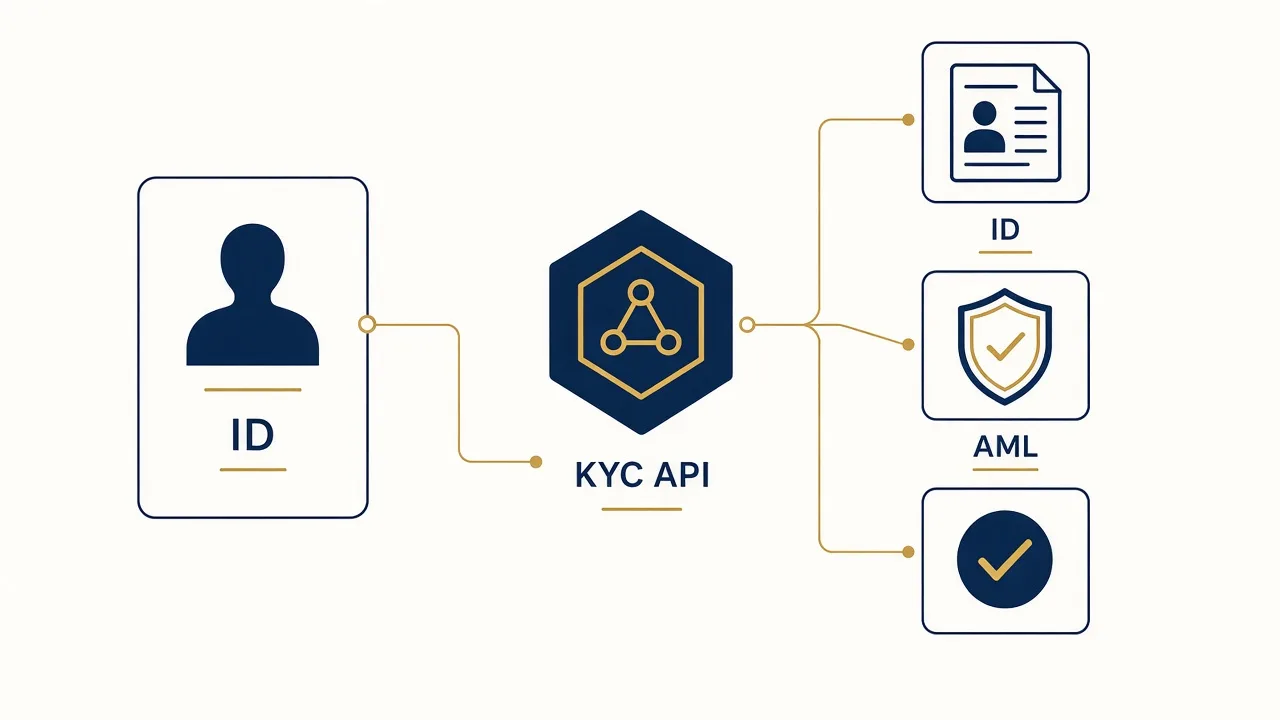
Quick Answer: A KYC API (Know Your Customer API) is a programmable interface that lets businesses embed identity verification, document checks, and AML screening directly into customer onboarding—so teams can verify who a customer is, assess risk in real time, and meet regulatory obligations without building verification infrastructure from scratch.
What Is a KYC API?
A KYC API is how regulated businesses run Know Your Customer checks inside their product—not in a side spreadsheet or email thread.
Instead of collecting IDs manually or bouncing between disconnected compliance tools, your system calls an API for KYC. The provider returns structured results—pass, fail, review needed, risk signals—so onboarding can continue without a handoff that kills conversion.
A modern Know Your Customer API usually covers more than a single ID check. It can combine:
- Identity and document verification
- Biometric / face-match steps (where required)
- Sanctions, PEP, and adverse media screening
- Address or bank-account validation
- Business and UBO checks when onboarding companies
If you are comparing a KYC verification API, an identity verification API, and a digital KYC API, you are usually making the same decision: how to verify customers at scale without rebuilding compliance infrastructure in-house.
Why Businesses Use a KYC API for Onboarding
Customer onboarding is where growth and compliance collide.
Banks, fintechs, payment providers, funds, crypto platforms, and insurers must verify who they are dealing with before (and often during) a business relationship. Manual KYC breaks when volumes rise, jurisdictions multiply, or product teams ship weekly—approvals stall, investigators drown in low-risk cases, and audit evidence gets patchy.
A KYC API helps organizations:
- Verify customers inside the product journey (not in a separate ops queue)
- Cut time-to-approve without skipping required checks
- Standardize decisions with audit-ready evidence
- Scale onboarding across markets with one integration pattern
- Free investigators to focus on true high-risk cases
If your team is comparing build vs buy, the practical question is rarely “Do we need KYC?” It is “How do we run KYC as software?”
How a KYC API Works
Most digital KYC flows follow a similar pattern, whether the UI is your own or a hosted verification link.
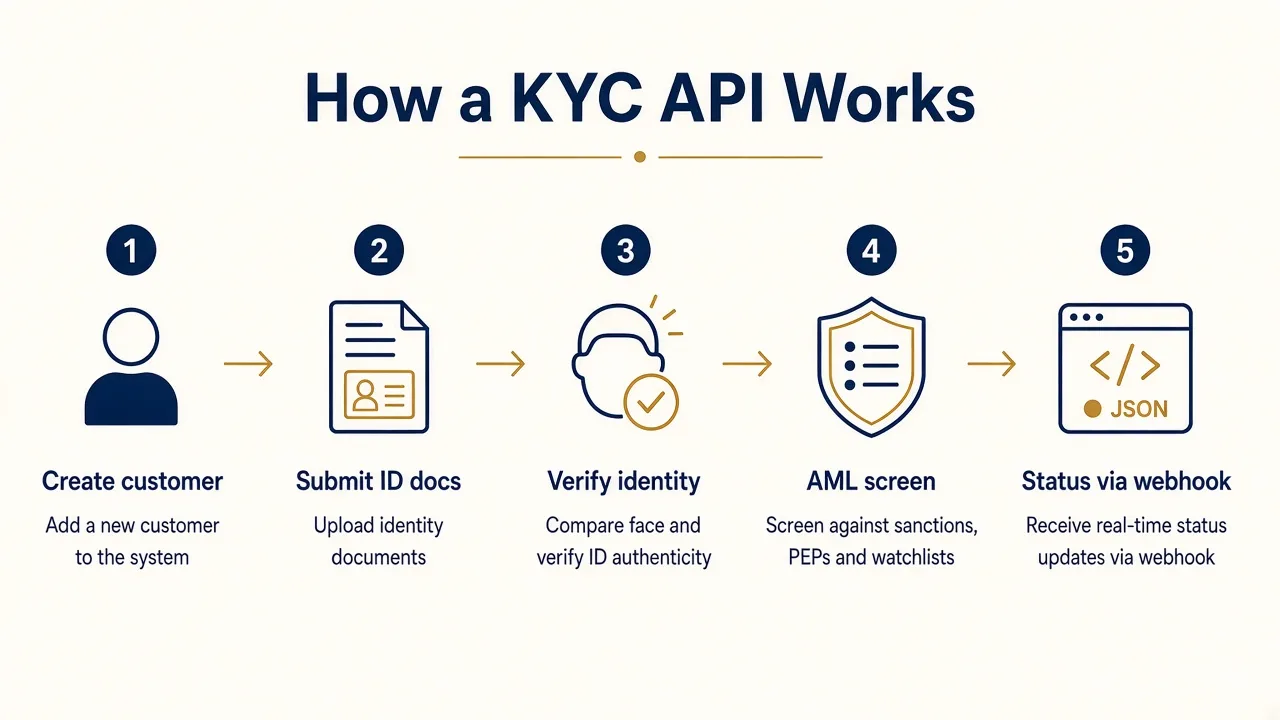
Typical KYC API workflow
- Your system creates a customer (or case) via API.
- The customer submits identity data and/or documents (app, web, or verification link).
- The provider runs document authenticity, data extraction, and identity matching.
- Optional biometric / liveness steps confirm the person matches the document.
- AML screening checks sanctions lists, PEPs, and adverse media.
- Risk signals and statuses return as JSON (and often via webhooks).
- Your workflow approves, declines, or escalates to manual review.
- Evidence stays available for audit, QA, and ongoing monitoring.
From an engineering view, integration is usually REST-based: create customer → submit documents / trigger screening → poll or receive webhooks → act on status. ClearDil’s docs walk through this path from API introduction through creating a customer and identity verification.
Core Capabilities Inside a Modern KYC Verification API
Not every “KYC API” offers the same depth. Before you build onboarding around a vendor, map capabilities to the risks you actually face.
| Capability | What it does | Why it matters |
|---|---|---|
| Document verification | Authenticate passports, ID cards, licences; extract MRZ/OCR data | Stops forged or mismatched IDs at intake |
| Identity / biometric checks | Face match, liveness, age signals | Confirms the applicant is the document holder |
| AML screening | Sanctions, PEP, adverse media, watchlists | Required risk signal for financial crime controls |
| Address / IBAN checks | Validate location or payment details | Reduces fraud and payment misdirection |
| KYB / UBO | Verify companies and beneficial owners | Needed when customers are legal entities |
| Case management | Queue reviews, evidence, decisions | Keeps humans in the loop for edge cases |
| Ongoing monitoring | Re-screen after onboarding | Risk changes after day one |
A narrow identity verification API may only cover documents and biometrics. A broader KYC API for regulated onboarding usually pairs identity with AML screening and review tooling—so compliance is not bolted on after growth teams ship.
KYC API vs Identity Verification API
These terms overlap in search, but they are not always the same product.
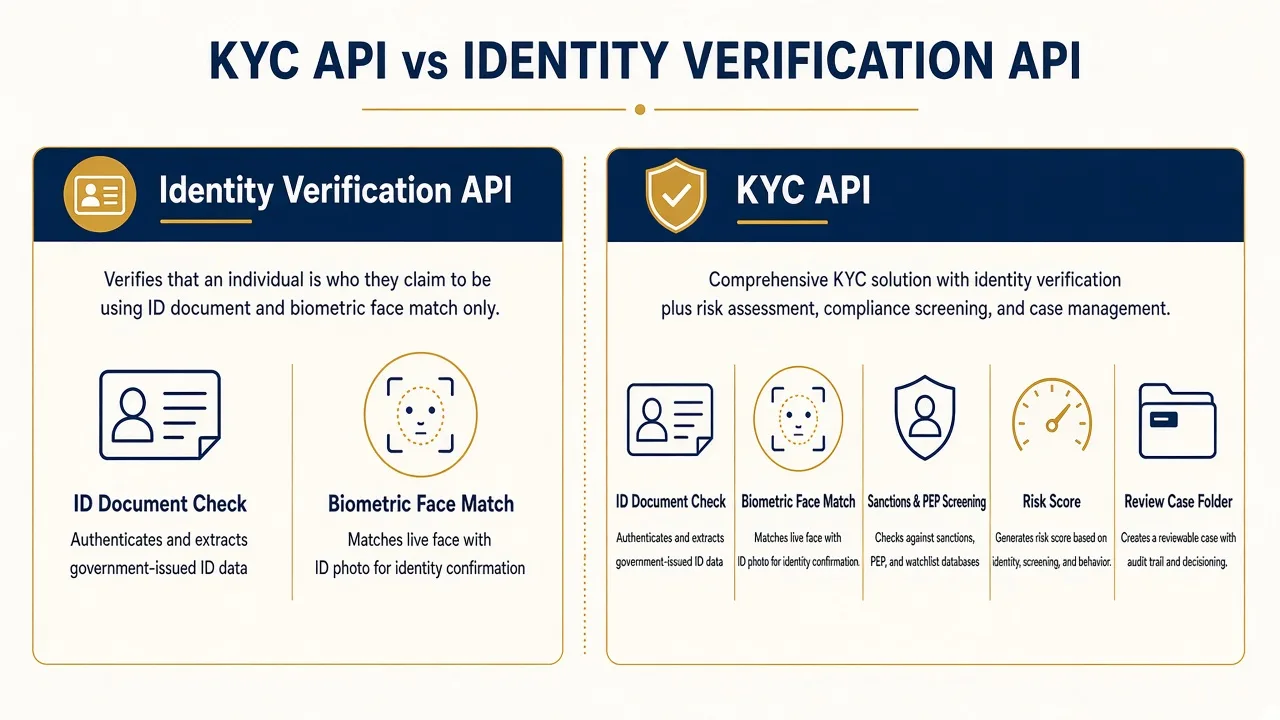
Identity verification API typically answers: Is this person who they claim to be?
Document authenticity, data consistency, and biometric matching sit here.
KYC API / Know Your Customer API typically answers: Should we establish (or continue) this customer relationship under our risk policy?
That includes identity—plus AML screening, risk scoring, escalation rules, and often business/UBO checks.
For many fintechs and FIs, buying only IDV leaves a second integration for screening. Buying a unified API for KYC reduces vendor sprawl and keeps one audit trail across onboarding.
Related reading: how AML automation and APIs replace manual compliance workflows, and how fintech compliance stacks combine KYC, screening, and monitoring.
What to Evaluate Before Integrating a KYC API
Use this checklist before you commit architecture and budget.
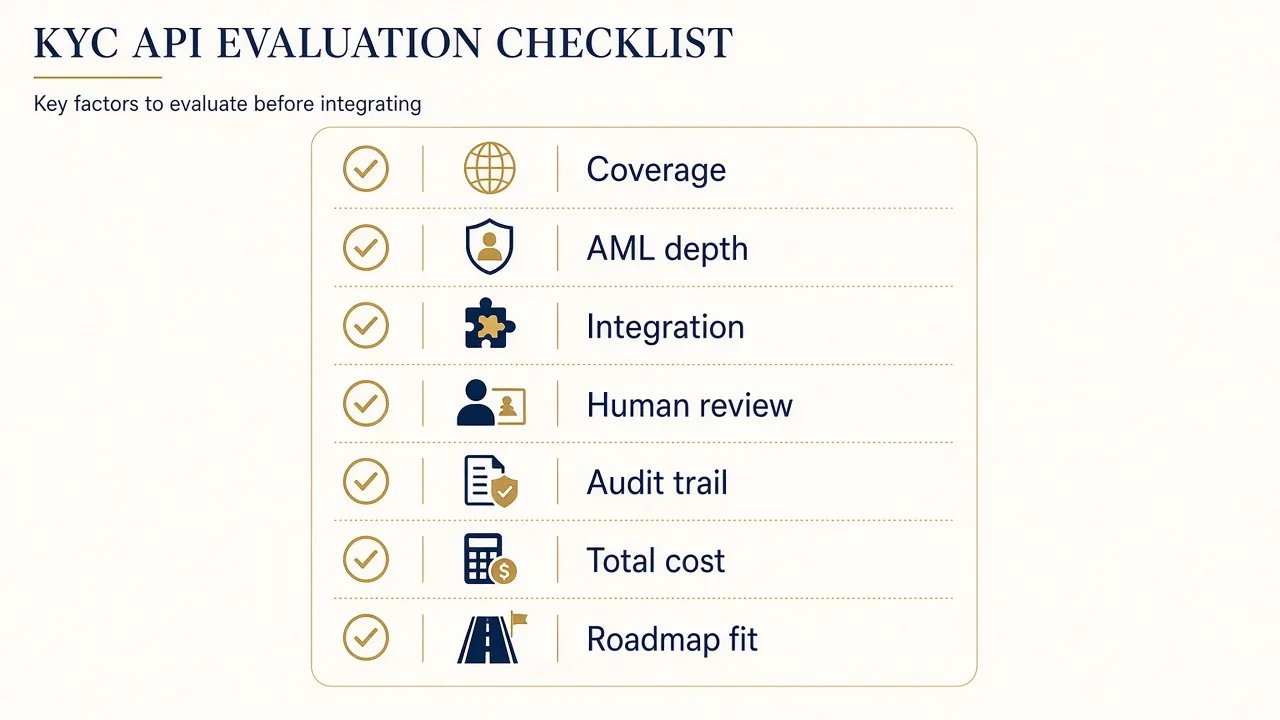
1. Coverage vs your customer mix
Individual consumers, SMEs, funds, and cross-border clients need different depth. Confirm document coverage by country, languages, and whether KYB / UBO identification is in-scope.
2. AML depth, not just IDV
Ask which lists and media sources are screened, how matches are scored, and how false positives are handled. Screening quality often determines investigator workload more than raw pass rates.
3. Integration model
Look for clear REST endpoints, webhooks, sandbox credentials, and a hosted verification flow link if you do not want to build every UI step. Review the API reference early—docs quality predicts implementation cost.
4. Decisioning and human review
Automation should not mean blind auto-approve. Confirm you can route edge cases into a case manager with evidence packs your compliance team can defend.
5. Auditability and data residency
Regulators expect reproducible evidence: who was checked, when, against what, and who decided. Clarify retention, encryption, and regional hosting needs up front.
6. Total cost to operate
Price per check matters, but so do false-positive rates, multi-vendor fees, and engineering time. A cheaper ID-only API can cost more once you add screening, UBO, and glue code.
7. Roadmap fit
Onboarding requirements evolve (new markets, EDD triggers, ongoing monitoring). Prefer an API-first platform that can grow with KYC onboarding and business onboarding—not a point tool you must replace in 18 months.
Build vs Buy: When an In-House KYC Stack Is the Wrong Bet
Building a full digital KYC stack means owning document fraud models, watchlist pipelines, UI capture quality, webhook reliability, and regulatory change. Most product companies underestimate the ongoing maintenance—not the first demo.
Buy (or buy and orchestrate) when:
- KYC is required but not your core product
- You need production-grade checks across many document types
- Compliance timelines are shorter than an ML/platform build
- You need sandbox → production with audit evidence from day one
Build selectively when:
- You have unique risk logic that must stay proprietary
- You already operate mature IDV/AML infra and only need orchestration
Even then, most teams still consume specialist APIs for documents, biometrics, or list screening rather than reinventing them.
Common Mistakes When Adopting a Digital KYC API
- Treating KYC as a one-time checkbox instead of a lifecycle control
- Integrating IDV and AML as two disconnected products with no shared customer ID
- Ignoring webhook/retry design (onboarding breaks when polling is the only pattern)
- Optimizing only for conversion and under-investing in review UX
- Skipping sandbox edge cases (expired docs, name mismatches, dual nationals)
- Forgetting business customers need KYB/UBO, not only retail ID checks
Avoiding these mistakes is often the difference between “we have a KYC vendor” and “we have a reliable onboarding system.”
How ClearDil Approaches KYC APIs
ClearDil’s KYC API combines identity and document checks, AML screening, address/IBAN validation, and UBO identification through one REST surface—with a free sandbox for developers and a case manager for compliance teams.
Teams evaluating KYC software can start in the docs, test flows in sandbox, then embed the same checks in production onboarding. Category clarity first; integration second.
Conclusion
A KYC API turns Know Your Customer from a manual bottleneck into a product capability: verify identity, run compliance checks, and decide with evidence—inside the onboarding flow.
Before you wire any digital KYC API into customer onboarding, clarify the checks you need, how humans will review exceptions, and whether identity and AML live in one integration or many. Teams that get those decisions right onboard faster, fail fewer audits, and avoid rewriting their compliance stack every time volume doubles.
Try the ClearDil KYC API
Frequently Asked Questions
What is a KYC API?
A KYC API is an application programming interface that lets businesses automate Know Your Customer checks—typically identity verification, document verification, and AML screening—inside their own onboarding systems.
How does a KYC API work?
Your application sends customer or document data to the provider. The provider runs verification and screening, then returns statuses and evidence via API responses or webhooks so you can approve, decline, or escalate the case.
What checks does a KYC verification API usually include?
Common checks include government ID verification, biometric/face match where used, sanctions and PEP screening, adverse media, and—when onboarding companies—business registry and UBO checks.
Is a KYC API the same as an identity verification API?
Not always. An identity verification API focuses on proving identity. A KYC API usually also includes AML screening and compliance workflow support so the relationship can be accepted under a risk policy.
What should businesses evaluate before choosing a KYC API?
Evaluate document/country coverage, AML screening quality, integration and webhook design, case management, audit evidence, data residency, pricing at scale, and whether KYB/UBO is included if you serve businesses.
Can a KYC API support both individuals and businesses?
Many platforms support individuals (KYC) and legal entities (KYB), including beneficial owner identification. Confirm coverage for your entity types and jurisdictions before integrating.