
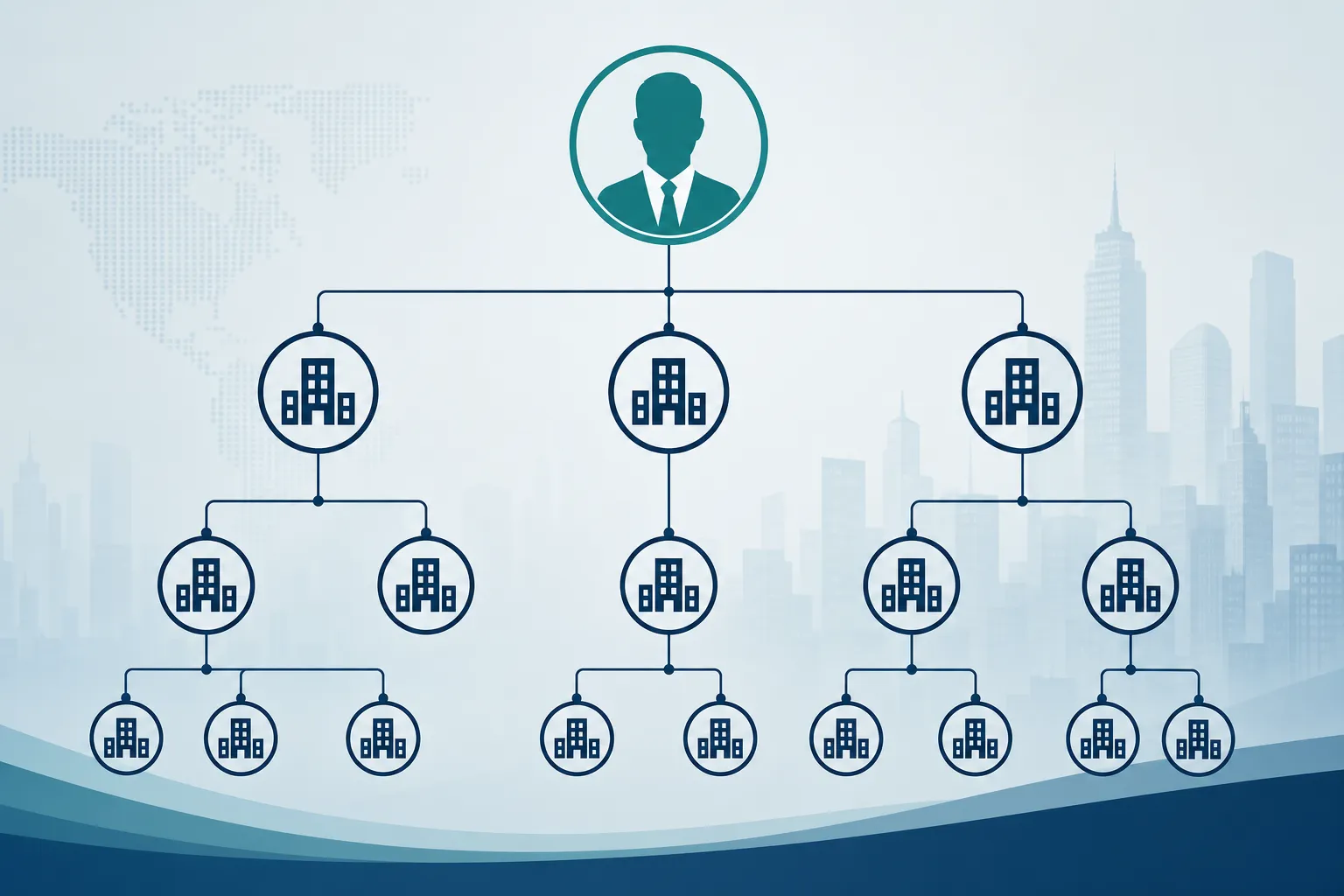
UBO identification is the process of determining the natural person or persons who ultimately own or control a business entity. A UBO (Ultimate Beneficial Owner) is typically an individual who directly or indirectly owns a significant percentage of a company or exercises substantial control over its operations.
For regulated businesses, financial institutions, fintech companies, payment providers, and other organizations subject to Anti-Money Laundering (AML) regulations, identifying beneficial owners is a critical component of Know Your Business (KYB) compliance.
As regulators worldwide continue to strengthen corporate ownership transparency requirements, organizations must accurately identify beneficial owners to prevent money laundering, terrorist financing, sanctions evasion, corruption, and financial crime.
Quick Answer: What Is UBO Identification?
UBO identification is the process of determining the natural persons who ultimately own or control a company through direct ownership, indirect ownership, or significant control relationships. This often involves analyzing ownership structures, corporate registries, shareholder records, and control relationships to trace ownership through multiple layers of entities until the ultimate natural persons are identified.
Why UBO Identification Matters
Criminal organizations frequently use complex corporate structures to conceal the true owners behind businesses. Without proper ownership transparency, companies may unknowingly conduct business with sanctioned individuals, politically exposed persons (PEPs), fraudsters, or entities involved in illicit activities.
Effective beneficial ownership identification helps organizations:
- Meet AML and KYB compliance requirements
- Reduce exposure to financial crime
- Detect hidden ownership risks
- Improve customer due diligence processes
- Comply with global regulatory expectations
- Strengthen risk assessment programs
- Support ongoing monitoring obligations
Regulators increasingly expect businesses to demonstrate a risk-based approach to beneficial ownership identification and verification.
Who Qualifies as an Ultimate Beneficial Owner?
Although ownership thresholds vary by jurisdiction, a UBO is generally an individual who:
- Owns 25% or more of a company directly or indirectly
- Exercises significant influence or control
- Controls voting rights
- Has authority to appoint or remove directors
- Benefits from company assets or profits
In some jurisdictions, lower ownership thresholds may apply to high-risk sectors or enhanced due diligence scenarios.
Examples of UBOs
Direct Ownership
If Sarah owns 60% of Company A directly, she is the UBO.
Indirect Ownership
Sarah owns 80% of Holding Company B, which owns 60% of Company A.
Sarah’s effective ownership:
80% × 60% = 48%
Since she ultimately controls 48% of Company A, she is considered a UBO.
Control Without Ownership
An individual may be considered a beneficial owner if they exercise substantial control over company decisions even without meeting ownership thresholds.
The UBO Identification Process
Organizations typically follow a structured ownership tracing process to identify beneficial owners. Modern platforms for UBO identification and verification automate many of these steps while keeping investigators in control of risk decisions.
Step 1: Collect Corporate Information
The process begins by gathering information about the business entity, including:
- Legal company name
- Registration number
- Jurisdiction of incorporation
- Directors and officers
- Shareholder information
- Corporate registration documents
This information forms the foundation for ownership analysis and KYB verification.
Step 2: Map Ownership Structures
Compliance teams analyze ownership relationships to understand who owns shares directly and indirectly.
Ownership structure mapping may involve:
- Parent companies
- Subsidiaries
- Holding companies
- Trusts
- Partnerships
- Investment vehicles
The goal is to create a complete ownership structure diagram.
Step 3: Trace Ownership Through Multiple Layers
Many organizations have multi-layer ownership structures that extend across jurisdictions.
Compliance teams must perform ownership tracing through every entity layer until they identify the natural persons behind the structure.
This process often requires reviewing:
- Corporate registries
- Shareholder records
- Regulatory filings
- Beneficial ownership databases
- Official company disclosures
Step 4: Identify Ultimate Natural Persons
Once all ownership layers are mapped, investigators identify the natural persons who meet ownership or control criteria.
These individuals become the organization’s identified beneficial owners. UBO discovery tools help surface these individuals even when ownership is fragmented across holding companies and cross-border entities.
Step 5: Conduct Risk Screening
After identifying beneficial owners, organizations perform additional due diligence checks, including:
- Sanctions screening
- PEP screening
- Adverse media monitoring
- Watchlist screening
- Risk assessments
This ensures organizations understand the compliance risks associated with each UBO. Integrating AML screening and watchlist monitoring at this stage connects ownership intelligence to broader financial crime controls.
Step 6: Maintain Ongoing Monitoring
Ownership structures change frequently.
Businesses should continuously monitor:
- Ownership changes
- Share transfers
- New directors
- Corporate restructurings
- Regulatory updates
Ongoing monitoring helps maintain compliance throughout the customer lifecycle.
Common Challenges in Beneficial Ownership Identification
Complex Corporate Structures
Large multinational organizations often operate through dozens or even hundreds of entities.
Tracing ownership through multiple jurisdictions can be highly resource-intensive.
Cross-Border Ownership
Beneficial owners may reside in countries different from the company’s registration jurisdiction.
This creates additional complexity when accessing reliable ownership information.
Nominee Shareholders
Nominee shareholders are frequently used to conceal actual ownership.
Organizations must look beyond nominee arrangements to identify the real beneficial owner.
Trust Structures
Trusts present unique challenges because ownership and control may be divided among:
- Settlors
- Trustees
- Protectors
- Beneficiaries
Understanding control relationships is essential when trusts are involved.
Incomplete Corporate Records
Some jurisdictions provide limited access to beneficial ownership information, making ownership tracing more difficult.
Manual vs Automated UBO Identification
Manual UBO Identification
Traditional ownership tracing relies on:
- Registry searches
- Document reviews
- Spreadsheet analysis
- Manual ownership calculations
While possible for simple organizations, manual approaches become inefficient for high-volume onboarding programs.
Automated UBO Identification
Modern compliance platforms automate:
- Entity resolution
- Ownership tracing
- Corporate registry analysis
- Beneficial ownership calculations
- Ongoing monitoring
Automation significantly reduces investigation time while improving consistency and accuracy.
Organizations handling large onboarding volumes increasingly rely on automated UBO identification solutions to scale compliance operations—often as part of broader AML compliance software for financial institutions.
Global Regulatory Expectations for UBO Identification
Regulators worldwide emphasize ownership transparency as a core AML requirement. Beneficial ownership regulations continue to expand across major markets.
Key frameworks include:
FATF Recommendations
The Financial Action Task Force (FATF) requires countries to ensure competent authorities can access accurate beneficial ownership information.
European Union AML Directives
EU AML regulations mandate beneficial ownership identification and customer due diligence procedures.
Corporate Transparency Requirements
Many jurisdictions now require companies to disclose beneficial ownership information through central registries.
Examples include:
- United States
- United Kingdom
- European Union member states
- Singapore
- Canada
- Australia
Organizations operating internationally must navigate varying ownership thresholds and reporting requirements.
Best Practices for UBO Identification
Establish a Risk-Based Framework
Not all entities present the same level of risk.
Higher-risk entities should receive enhanced ownership investigations as part of a risk-based AML approach.
Use Multiple Data Sources
Relying on a single registry may create blind spots.
Combine:
- Corporate registries
- Beneficial ownership databases
- Regulatory filings
- Commercial intelligence sources
Automate Ownership Mapping
Automation reduces manual effort and improves consistency across ownership structure mapping workflows.
Monitor Ownership Changes Continuously
Beneficial ownership information can become outdated quickly.
Real-time ownership monitoring helps maintain compliance.
Integrate UBO Identification Into KYB Workflows
Ownership identification should be embedded directly into customer onboarding and periodic review processes.
How UBO Identification Supports AML Compliance
UBO identification is a foundational element of AML compliance because it helps organizations understand who they are truly doing business with.
When combined with:
- KYB verification
- AML screening
- Risk assessments
- Ongoing monitoring
UBO identification enables organizations to build a comprehensive view of customer risk.
This supports stronger compliance programs, reduces exposure to financial crime, and helps satisfy regulatory expectations.
Frequently Asked Questions
What is UBO identification?
UBO identification is the process of determining the natural persons who ultimately own or control a company, directly or indirectly.
Why is UBO identification important?
It helps organizations comply with AML regulations, prevent financial crime, and improve ownership transparency.
What percentage ownership qualifies as a UBO?
In many jurisdictions, individuals who own 25% or more of a company are considered beneficial owners, although thresholds may vary.
How do companies identify beneficial owners?
Organizations analyze ownership structures, corporate registries, shareholder records, and control relationships to trace ownership to the ultimate natural persons.
What is the difference between UBO identification and UBO verification?
Identification determines who the beneficial owners are. Verification confirms that the identified owners are real individuals using reliable data sources and documentation.
Conclusion
UBO identification is no longer a regulatory checkbox—it is a critical component of modern AML and KYB compliance programs. As ownership structures become more complex and regulatory scrutiny increases, organizations must be able to identify, understand, and monitor the individuals behind corporate entities.
By combining ownership structure mapping, risk-based due diligence, ongoing monitoring, and automation, businesses can improve compliance outcomes while reducing operational burden and onboarding friction.