
Quick Answer: A KYC verification API is a programmable interface that runs identity checks, document verification, and AML screening in real time during customer onboarding—returning structured pass, fail, or review statuses so your product can decide without building verification infrastructure in-house.
What Is a KYC Verification API?
A KYC verification API is how regulated businesses prove who a customer is—and whether the relationship is acceptable under their risk policy—inside the product journey.
Instead of collecting IDs by email or parking applicants in a separate compliance portal, your system calls an API for KYC verification. The provider runs document authenticity checks, identity matching, and often sanctions/PEP/adverse media screening, then returns machine-readable results your workflow can act on immediately.
A modern Know Your Customer API used for verification typically combines:
- Document verification (passport, national ID, licence)
- Identity verification and biometric / face-match steps where required
- Real-time AML screening (sanctions, PEPs, adverse media)
- Optional address or payment-detail validation
- Business and UBO checks when onboarding companies
If you are searching for a customer verification API, a document verification API, or real-time KYC, you are usually solving the same problem: verify applicants at scale without rebuilding compliance infrastructure for every market you enter.
For a broader product definition, see What is a KYC API?.
Why Real-Time Verification Matters for Onboarding
Growth teams optimize for conversion. Compliance teams optimize for defensible decisions. Real-time KYC is where those goals meet.
When verification is asynchronous and opaque—manual queues, overnight batch screening, unclear statuses—applicants drop off and investigators inherit incomplete cases. A KYC verification API keeps checks inside the KYC onboarding path:
- Applicants finish in minutes, not days
- Risk signals arrive before the account is fully activated
- Evidence packs stay tied to the same customer ID
- Reviewers only see exceptions, not every low-risk file
Banks, fintechs, payment providers, funds, and crypto platforms all face the same pressure: more volume, more jurisdictions, shorter product cycles. Manual KYC does not survive that mix.
How a KYC Verification API Works
Most identity verification workflows follow a predictable pattern—whether the UI is yours or a hosted verification link.
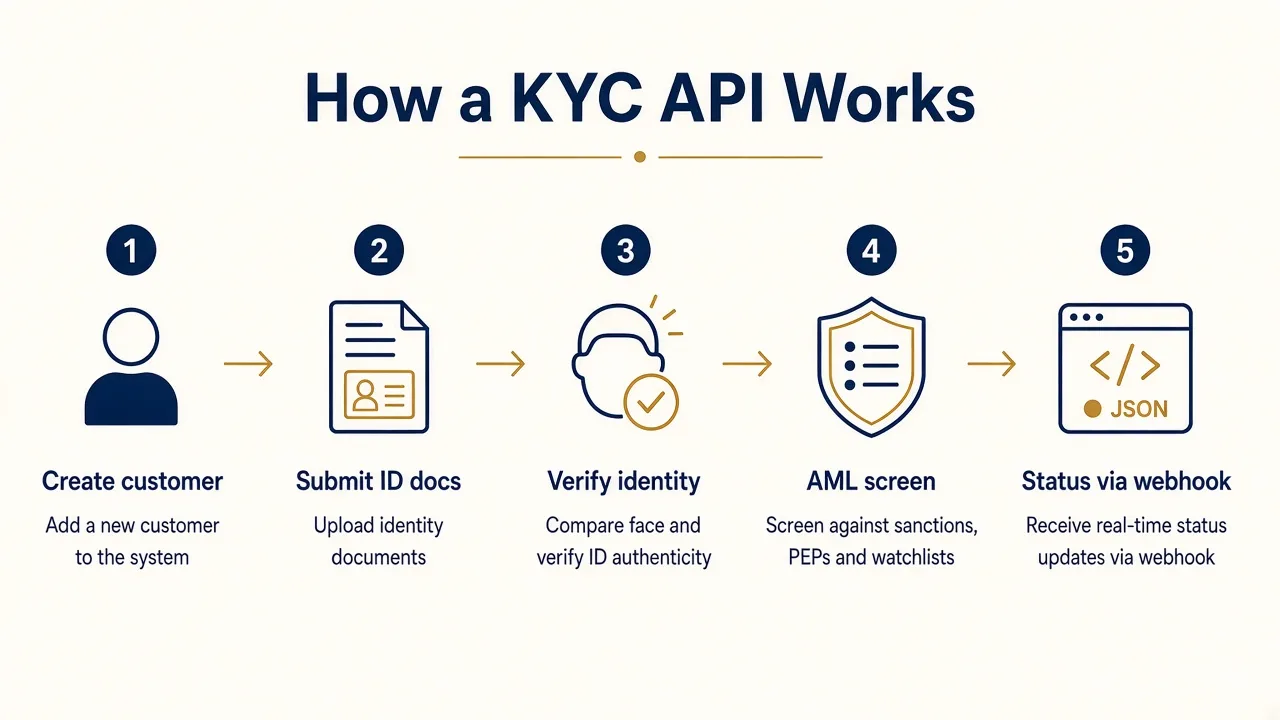
Typical identity verification workflow
- Your system creates a customer (or case) via API.
- The customer submits identity data and/or documents (app, web, or verification link).
- The provider runs document authenticity, OCR/MRZ extraction, and data consistency checks.
- Optional biometric / liveness steps confirm the person matches the document.
- AML screening checks sanctions lists, PEPs, and adverse media.
- Statuses and risk signals return as JSON (and often via webhooks).
- Your workflow approves, declines, or escalates to manual review.
- Evidence remains available for audit, QA, and ongoing monitoring.
From an engineering view, the path is usually REST-based: create a customer → trigger verification / document capture → screen the customer → poll or receive webhooks → act on status. ClearDil’s docs cover this from API introduction through identity and document verification guides.
What a Document Verification API Checks
Document verification is often the first concrete step inside a KYC verification API—and a common search intent on its own.
A document verification API typically:
- Confirms the document type and issuing country are supported
- Checks security features and forgery signals where models allow
- Extracts fields (name, DOB, document number, expiry) via OCR/MRZ
- Compares extracted data to what the applicant typed
- Flags expired, damaged, or inconsistent documents for review
Document checks alone do not equal full KYC. They answer “Is this document plausible and consistent?” Full Know Your Customer coverage also asks whether the person should be onboarded under sanctions, PEP, and risk policy controls.
Use document verification docs when scoping capture UX; use the broader KYC API when you need identity plus screening in one integration.
Core Capabilities in a Modern Customer Verification API
Not every vendor means the same thing by “verification.” Map capabilities to the risks you actually face.
| Capability | What it does | Why it matters |
|---|---|---|
| Document verification | Authenticate IDs; extract and match data | Stops forged or mismatched documents at intake |
| Identity / biometric checks | Face match, liveness, age signals | Confirms the applicant is the document holder |
| AML screening | Sanctions, PEP, adverse media | Required risk signal for financial crime controls |
| Address / IBAN checks | Validate location or payment details | Reduces fraud and payment misdirection |
| KYB / UBO | Verify companies and beneficial owners | Needed when customers are legal entities |
| Case management | Queue reviews with evidence | Keeps humans in the loop for edge cases |
| Ongoing monitoring | Re-screen after onboarding | Risk changes after day one |
A narrow identity product may stop at documents and biometrics. A regulated onboarding stack usually pairs those checks with AML screening and review tooling—so compliance is not bolted on after growth ships.
KYC Verification API vs Identity-Only Checks
Search results blur these terms. Product scope should not.
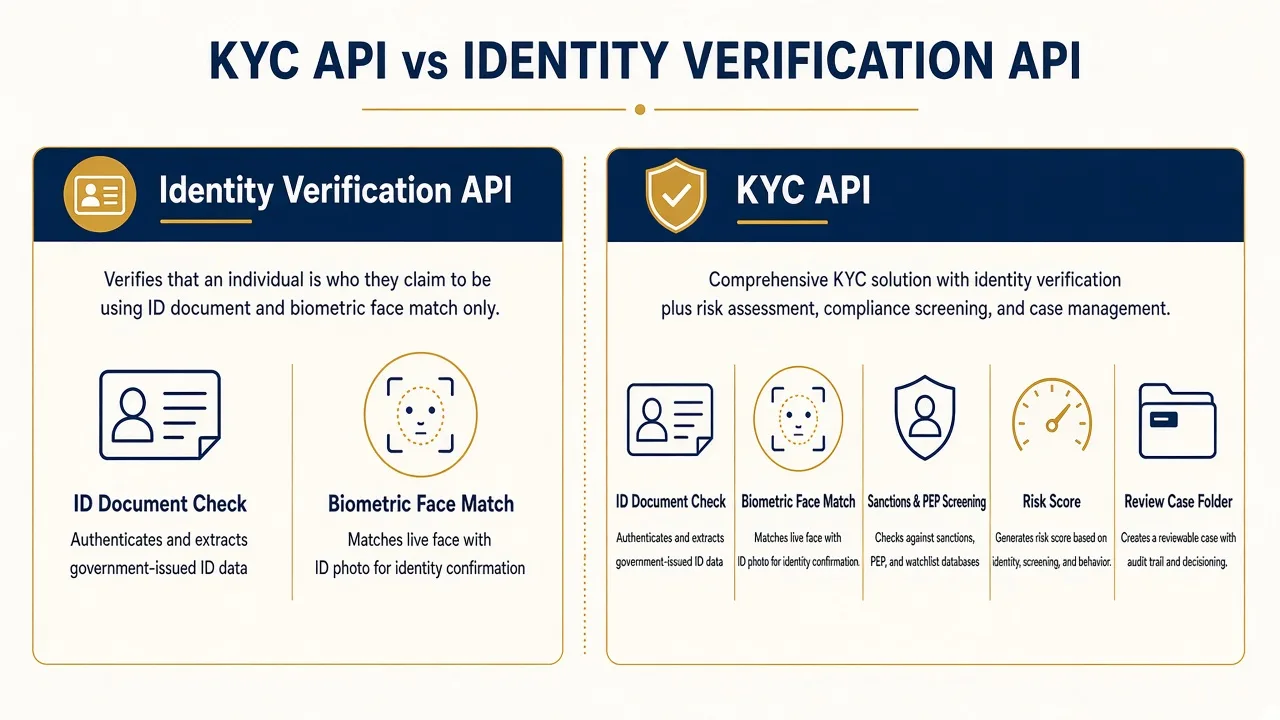
Identity verification typically answers: Is this person who they claim to be?
Document authenticity, data consistency, and biometric matching sit here.
KYC verification / Know Your Customer typically answers: Should we establish (or continue) this customer relationship under our risk policy?
That includes identity—plus AML screening, escalation rules, and often business/UBO checks via business onboarding and UBO identification.
Buying only IDV often leaves a second integration for screening. A unified KYC verification API reduces vendor sprawl and keeps one audit trail across onboarding.
Related reading: AML automation via APIs and fintech compliance stacks.
Real-Time KYC: Latency, Webhooks, and Decisioning
“Real-time” does not mean every check finishes in 200ms. It means your product receives an actionable status soon enough to keep the applicant in flow.
Practical patterns:
- Synchronous response for quick document/identity results when the provider can return immediately
- Webhooks when screening or secondary checks need seconds to minutes
- Review queues when automation cannot safely auto-approve
- Hosted verification flow links when you do not want to build every capture screen
Design for retries and idempotency. Onboarding that only polls once and gives up creates silent failed applicants—and incomplete evidence for auditors.
What to Evaluate Before You Integrate
Before you commit architecture:
- Document and country coverage for your customer mix
- AML depth (lists, media sources, match handling)—not only IDV pass rates
- Integration quality — REST clarity, webhooks, sandbox, API reference
- Human review — evidence packs compliance can defend
- Auditability — who was checked, when, against what, who decided
- Total cost — false positives and glue code often dwarf per-check price
- Roadmap — KYB/UBO, ongoing monitoring, new markets without a rip-and-replace
Category clarity first; vendor demos second.
Common Mistakes With Real-Time KYC APIs
- Treating document upload as “done” without screening
- Separating IDV and AML across vendors with no shared customer ID
- Ignoring webhook/retry design
- Optimizing only for conversion and under-investing in review UX
- Skipping sandbox edge cases (expired docs, name mismatches, dual nationals)
- Forgetting business customers need KYB/UBO, not only retail ID checks
Avoiding these mistakes is the difference between “we have a verification vendor” and “we have a reliable onboarding system.”
How ClearDil Approaches KYC Verification
ClearDil’s KYC API combines identity and document checks, AML screening, address/IBAN validation, and UBO identification through one REST surface—with a free sandbox for developers and a case manager for compliance teams.
Teams evaluating KYC software can start in the docs, test flows in sandbox, then embed the same checks in production onboarding.
Conclusion
A KYC verification API turns real-time identity verification into a product capability: check documents, confirm identity, run AML screening, and decide with evidence—inside onboarding, not beside it.
Before you integrate any API for KYC verification, clarify which checks you need, how humans review exceptions, and whether identity and screening share one customer record. Teams that get those decisions right onboard faster and carry cleaner audit trails.
Try the ClearDil KYC API
Frequently Asked Questions
What is a KYC verification API?
A KYC verification API is an interface that lets businesses automate Know Your Customer checks—typically identity verification, document verification, and AML screening—inside their own onboarding systems and receive structured results in near real time.
How does real-time KYC verification work?
Your application creates a customer, collects identity or document data, and triggers verification and screening. The provider returns statuses via API responses or webhooks so you can approve, decline, or escalate without leaving the product flow.
What does a document verification API check?
It typically authenticates government IDs, extracts fields via OCR/MRZ, checks consistency and expiry, and flags anomalies for review. Document checks are usually one layer inside a broader KYC verification API.
Is a customer verification API the same as KYC?
Often in marketing language, yes—but confirm scope. Some customer verification APIs only prove identity. Full KYC usually also includes AML screening and compliance decisioning.
How long does API-based KYC verification take?
Many identity and document checks complete within seconds. Screening and edge-case review can take longer. Design for webhooks and clear “pending review” states so applicants are not left without status.
Can a KYC verification API support ongoing monitoring?
Many platforms support re-screening and ongoing due diligence after onboarding. Confirm monitoring cadence, alert routing, and evidence retention if risk can change after day one.