
Quick Answer: Under AMLR (Regulation (EU) 2024/1624), payment institutions, e-money institutions, and CASPs (crypto-asset service providers under MiCA—formerly PSANs in many member states) must collect a harmonised customer due diligence file. AMLA’s draft RTS under Article 28(1) lists the information to collect and verify. The draft RTS under Article 19(9) decides when currency exchange, funds transfers, and certain crypto services become a business relationship—so the full Article 22 file and ongoing monitoring apply earlier. Both drafts were transmitted to the European Commission on 1 October 2026; they are not yet in the Official Journal. AMLA proposes they apply six months after entry into force. The AMLR itself applies on 10 July 2027.
Why AMLR raises the client-data bar for PSPs and CASPs
For years, EU CDD practice was fragmented across national AMLD transposition. AMLR replaces that patchwork with a regulation: the same baseline identity and relationship data for obliged entities across the Union.
For payment service providers and CASPs, the practical question is not “do we do KYC?” It is: which fields are mandatory, what still drops in low risk, and when an occasional transaction flips into a business relationship. The answers sit in two AMLA drafts—not in marketing checklists.
Use ClearDil’s AMLR 2027 Readiness Scorecard to stress-test your data model against those rules, and keep product CDD flows aligned with AML for payment service providers.
Key dates and status of the RTS
-
Past
1 Oct 2026
Draft RTS Article 28(1) — CDD information list
Status Final draft sent to Commission 1 Oct 2026; not yet OJ
Timing AMLA proposes application 6 months after entry into force
-
Past
1 Oct 2026
Draft RTS Article 19(9) — business relationships, occasional & linked transactions, lower thresholds
Status Final draft sent to Commission 1 Oct 2026; not yet OJ
Timing AMLA proposes application 6 months after entry into force
-
Upcoming
10 July 2027
AMLR — Regulation (EU) 2024/1624
Status Adopted Level 1
Timing Applies 10 July 2027
-
Upcoming
10 July 2027
Article 40 self-hosted wallet measures
Status In AMLR; detailed guidance via AMLA guideline (not an RTS)
Timing Guideline mandate keyed to 10 July 2027
Official package: AMLA finalises key standards for the private sector (1 October 2026), with final reports and factsheets for both RTS.
Until OJ publication, treat the drafts as the best available specification for build work—not as binding law.
Information you must collect
RTS under article 28
This is the text that details what AMLR obliges you to collect. It applies to all obliged entities, including payment institutions, e-money institutions, and CASPs (AMLR Article 2(1)(6)(i)—crypto-asset service providers within the meaning of MiCA).
Primary sources:
It operationalises Article 22 AMLR (standard CDD information).
Under AMLD4 and AMLD5, Article 13 required identify-and-verify from a reliable source—but it did not lock an EU-wide field list. Many firms still collected richer identity data as good practice. AMLR Article 22 and the draft RTS under Article 28(1) turn that practice into a mandatory minimum for every obliged entity.
Rule type
EU text set principles only; richer fields were optional industry / national practice
Mandatory harmonised information list (Regulation + RTS)
Natural Person CDD — Under the Old Rules vs New Rules
| Field | Old rules under AMLD4/5 | New rules under AMLR |
|---|---|---|
| ID verification | Required Already mandatory in principle (Art. 13) — verify from a reliable source | Required Still mandatory — RTS adds how (sources, eID, non-face-to-face) |
| Full name | Optional Usually collected — good practice, not an EU-mandated string | Required All first and last names as on the identity document |
| Place of birth | Optional Not required in the directive; optional or incomplete where collected | Required As on the document (country, state/region, city); stays even in low risk |
| Date of birth | Optional Common good practice; not locked as an EU minimum field | Required Full date of birth |
| Nationality | Optional Often collected in practice; verification depth varied | Required Nationalities (at least one verified); stays even in low risk |
| National ID number | Optional Good practice only where national law or policy asked for it | Required Where applicable |
| Address | Optional Usual residence often collected; structure not EU-standardised | Required Habitual address in structured components (may drop only in low risk) |
| Tax ID number | Optional Rarely treated as EU CDD good practice, let alone a minimum | Required Where one exists (may drop only in low risk) |
Sources: Directive (EU) 2015/849 Art. 13; Directive (EU) 2018/843; Regulation (EU) 2024/1624 Art. 22; draft RTS under Art. 28(1) AMLR.
Low risk does not empty the dossier. Even under simplified measures, place of birth and nationalities remain required. Only address and tax number may fall away (RTS Article 18).
That single line is where many onboarding forms will break after 2027 if they still treat nationality and place of birth as “optional extras.”
For companies, AMLD4/5 already required identifying the customer and the beneficial owner, and understanding ownership and control—but again without an EU-wide corporate data checklist. Strong KYB programmes treated many fields as good practice. AMLR Article 22(1)(b) and the draft RTS make that checklist required.
Rule type
Identify the legal person + UBO; corporate field detail left to national law and KYB practice
Mandatory corporate information list in Art. 22(1)(b) + RTS detail
Legal Person CDD — Under the Old Rules vs New Rules
| Field | Old rules under AMLD4/5 | New rules under AMLR |
|---|---|---|
| Beneficial ownership | Required Already mandatory in principle (identify & verify UBO; ownership structure) | Required Still mandatory — plus RTS detail on intermediate holding chains |
| Legal form | Optional Usually captured in onboarding packs — good practice, not an EU field list item | Required Legal form of the entity |
| Name / trading name | Optional Company name always collected in practice; trading name often optional | Required Name and, where different, trading name |
| Registration / tax / LEI | Optional Company number usual practice; tax ID and LEI uneven | Required Where available: registration number, tax ID, and LEI |
| Registered office | Optional Registered address common good practice; principal place of business often weaker | Required Registered/official office and, if different, principal place of business |
| Legal representatives | Optional Directors / signatories commonly collected where risk justified | Required Names of legal representatives |
| Country of creation | Optional Often inferred from docs; not a fixed EU CDD field | Required Country of creation / incorporation |
| Nominee shareholders / directors | Optional Sometimes explored in enhanced KYB; rarely standardised | Required Where used — including status as nominee |
Sources: Directive (EU) 2015/849 Art. 13; Regulation (EU) 2024/1624 Art. 22(1)(b); draft RTS under Art. 28(1) AMLR (incl. Art. 11 ownership chain).
Pair this with robust business onboarding (KYB) and UBO identification—AMLR expects you to know who stands behind the entity, not only the company name on the invoice.
Beyond identity: purpose, ownership chain, virtual IBAN
The RTS goes past static identity:
1. Purpose and nature of the relationship (RTS Article 16, developing AMLR Article 25)
Collect, to the extent risk requires: intended use, estimated volumes, source of funds, destination of funds, and occupation or business activity. This is relationship intelligence—not a marketing survey.
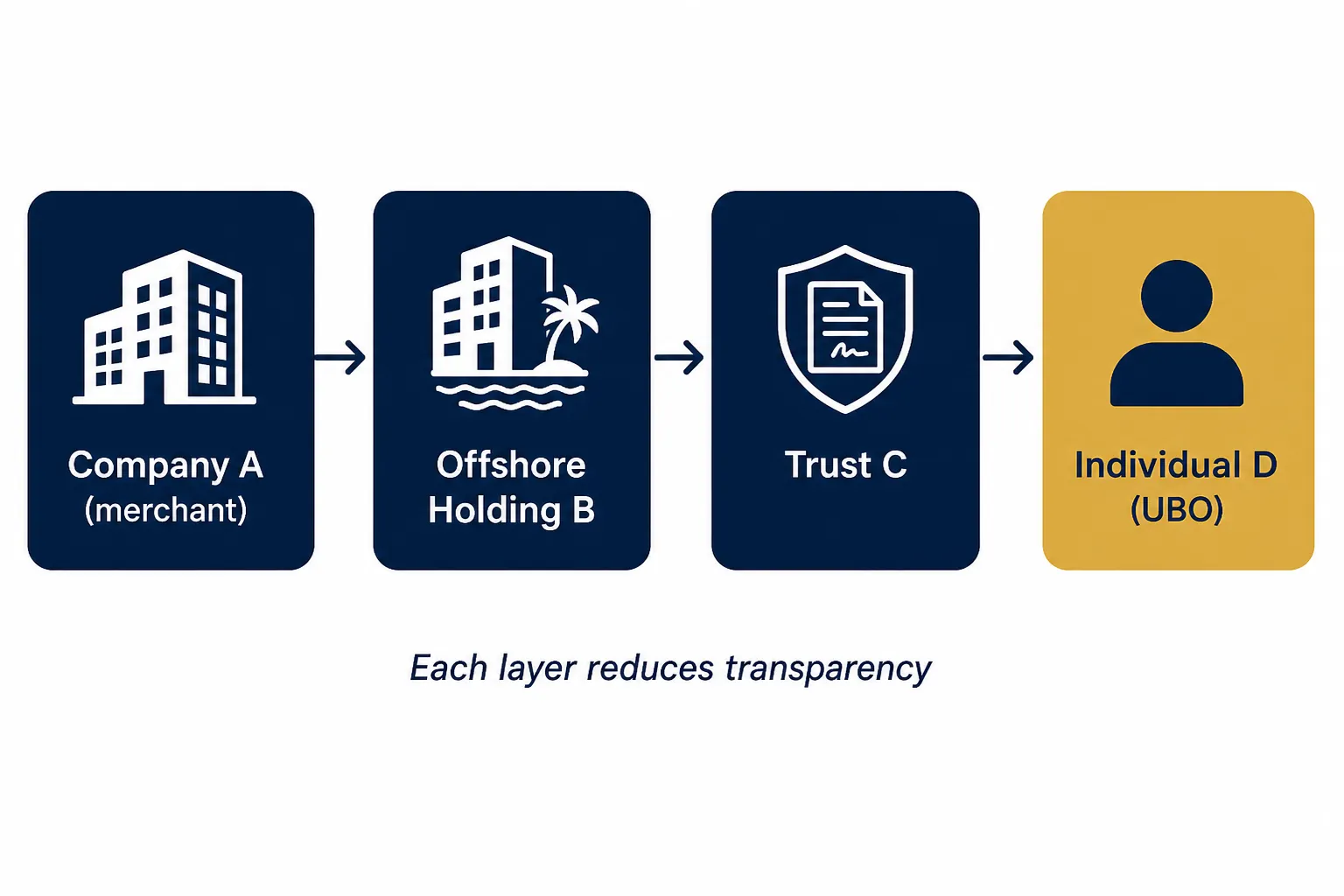
2. Intermediate holding chain (RTS Article 11)
Form of each layer, nominees, jurisdiction, ownership and voting rights. Hidden control through multi-layer structures is in scope.
3. Virtual IBAN issuers (common for payment providers) — RTS Article 9 / AMLR Article 22(3)
Collect the full Article 22 identity of the user, plus the virtual IBAN, the linked payment account, and the account’s opening and closing dates.
If your product issues vIBANs, your customer object and your account object must stay joined in one audit trail—not split across billing and compliance tools. ClearDil’s create customer and ongoing due diligence flows are designed for that joined record.
When that knowledge becomes mandatory for FX, remittance, and crypto
RTS under article 19
This RTS does not invent new data fields. It pulls more activity into a business relationship earlier—so Article 22 CDD and continuous monitoring apply in full.
Primary sources:
Activities named in the draft
RTS Article 2(4) expressly covers:
- Currency exchange offices
- Money remittance (PSD2 Directive (EU) 2015/2366, Article 4(22))
- Three MiCA crypto services (Regulation (EU) 2023/1114, Article 3(1), points (16)(c), (d) and (j)):
- exchange of crypto-assets for funds
- exchange of crypto-assets for other crypto-assets
- transfer of crypto-assets on behalf of clients
Three or more operations in the last twelve months is an indicator of repetition—and therefore of a business relationship.
RTS Article 3(2) shortens the window for treating operations as linked to one month.
Thresholds: AMLR Level 1, not a softer AMLA floor
AMLA did not add lower thresholds beyond those already in AMLR. Those Level 1 thresholds are already stricter than the general EUR 10,000 occasional-transaction line:
| Rule | Who | Trigger |
|---|---|---|
| AMLR Article 19(2) | Credit and financial institutions other than CASPs | Full CDD from an occasional funds transfer of EUR 1,000 |
| AMLR Article 19(3) | CASPs | Full CDD from EUR 1,000; below that, at least identification and identity verification under Article 20(1)(a) for every occasional transaction |
Continuous-access accounts = business relationship at opening
A payment account or e-money account with continuous access is a business relationship from opening (RTS Article 2(1)). You do not wait for a third operation before applying the Article 22 dossier.
That matters for wallets, IBAN products, and stored-value accounts: onboarding is the CDD moment.
What sits in AMLR itself—not in an RTS
For CASPs, Article 40 AMLR requires, on transfers to or from a self-hosted address, identification and verification of the originator or beneficiary, and the ability to obtain additional information on the origin and destination of the crypto-assets.
The corresponding detail mandate is an AMLA guideline by 10 July 2027, not an RTS. Do not wait for the Article 28/19 packages alone if you handle unhosted wallets—build the Article 40 controls on the Level 1 text and track the forthcoming guideline.
What compliance and product teams should do now
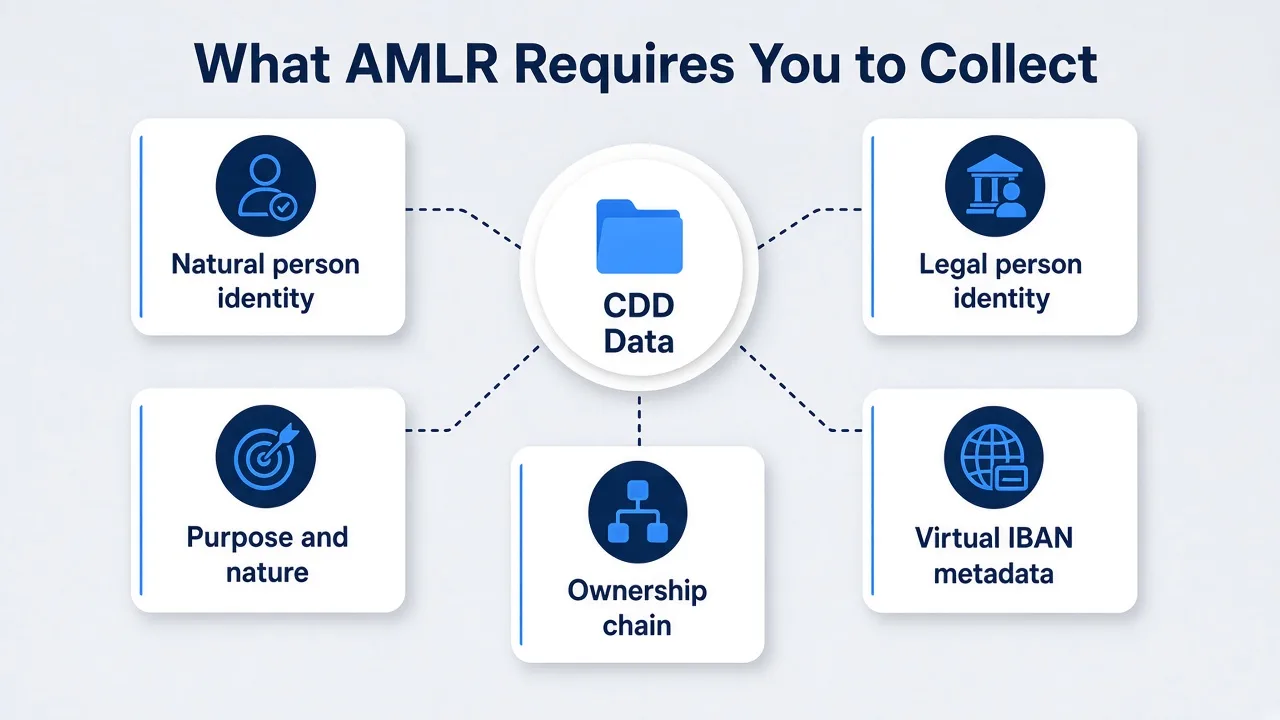
- Inventory fields against RTS Article 28(1): natural person, legal person, purpose/nature, intermediate ownership, vIBAN metadata.
- Lock low-risk rules: never drop place of birth or nationality in SDD flows.
- Wire relationship detection for FX, remittance, and MiCA exchange/transfer services (3+ / 12 months; 1-month linked window).
- Treat continuous-access accounts as CDD-at-opening, with ongoing monitoring from day one.
- Plan Article 40 self-hosted wallet evidence separately from the RTS build.
- Automate capture and verification so the dossier is complete at decision time—see identity verification, document checks, AML screening, and the broader fintech AML stack.
Conclusion
AMLR customer data collection for PSPs and CASPs is no longer a national best-guess list. The Article 28(1) draft RTS fixes the fields; the Article 19(9) draft RTS pulls FX, remittance, and crypto activity into full CDD earlier; AMLR Level 1 already sets EUR 1,000 triggers and self-hosted wallet duties. The regulation applies on 10 July 2027. The RTS still await Official Journal publication, with AMLA proposing application six months after they enter into force—so the build window is now, not after the OJ PDF lands.
Ready for AMLR 2027?
Map your CDD data model before July 2027. Pick one path:
- ClearDil — assess gaps with the AMLR 2027 Readiness Scorecard
- Explore — see how AML for payment service providers covers PSP workflows
- Try — open a free KYC API account
Frequently Asked Questions
What customer data does AMLR require for natural persons?
Standard CDD for a natural person includes all names on the identity document, place of birth as shown, full date of birth, nationalities (at least one verified), national ID number where applicable, structured habitual address, and tax number where one exists—per AMLR Article 22 and the draft RTS under Article 28(1).
What additional data does AMLR require for legal persons?
Legal persons require legal form, name and trading name, registered office and principal place of business if different, country of incorporation, legal representatives, nominee shareholders or directors where used, and registration number, tax number, and LEI where they exist—plus ownership-chain and purpose-of-relationship information as risk requires.
When do the AMLA RTS on CDD apply?
AMLA transmitted the final draft RTS under Articles 28(1) and 19(9) to the Commission on 1 October 2026. They are not yet in the Official Journal. AMLA proposes they apply six months after entry into force. AMLR itself applies on 10 July 2027.
Does low risk remove place of birth or nationality under AMLR?
No. Under the draft RTS Article 18, even in lower-risk situations place of birth and nationalities remain required. Address and tax number are the fields that may drop.
When does FX, remittance, or crypto activity become a business relationship?
Under the draft RTS Article 19(9), currency exchange, money remittance, and specified MiCA crypto exchange/transfer services treat three or more operations in twelve months as an indicator of a business relationship. Linked operations use a one-month window. Continuous-access payment or e-money accounts are business relationships from opening.
What does AMLR require for self-hosted wallet transfers?
Article 40 AMLR requires CASPs to identify and verify the originator or beneficiary on transfers to or from a self-hosted address and to be able to obtain further information on origin and destination of the crypto-assets. Detailed application is expected via an AMLA guideline by 10 July 2027, not via the Article 28/19 RTS.