
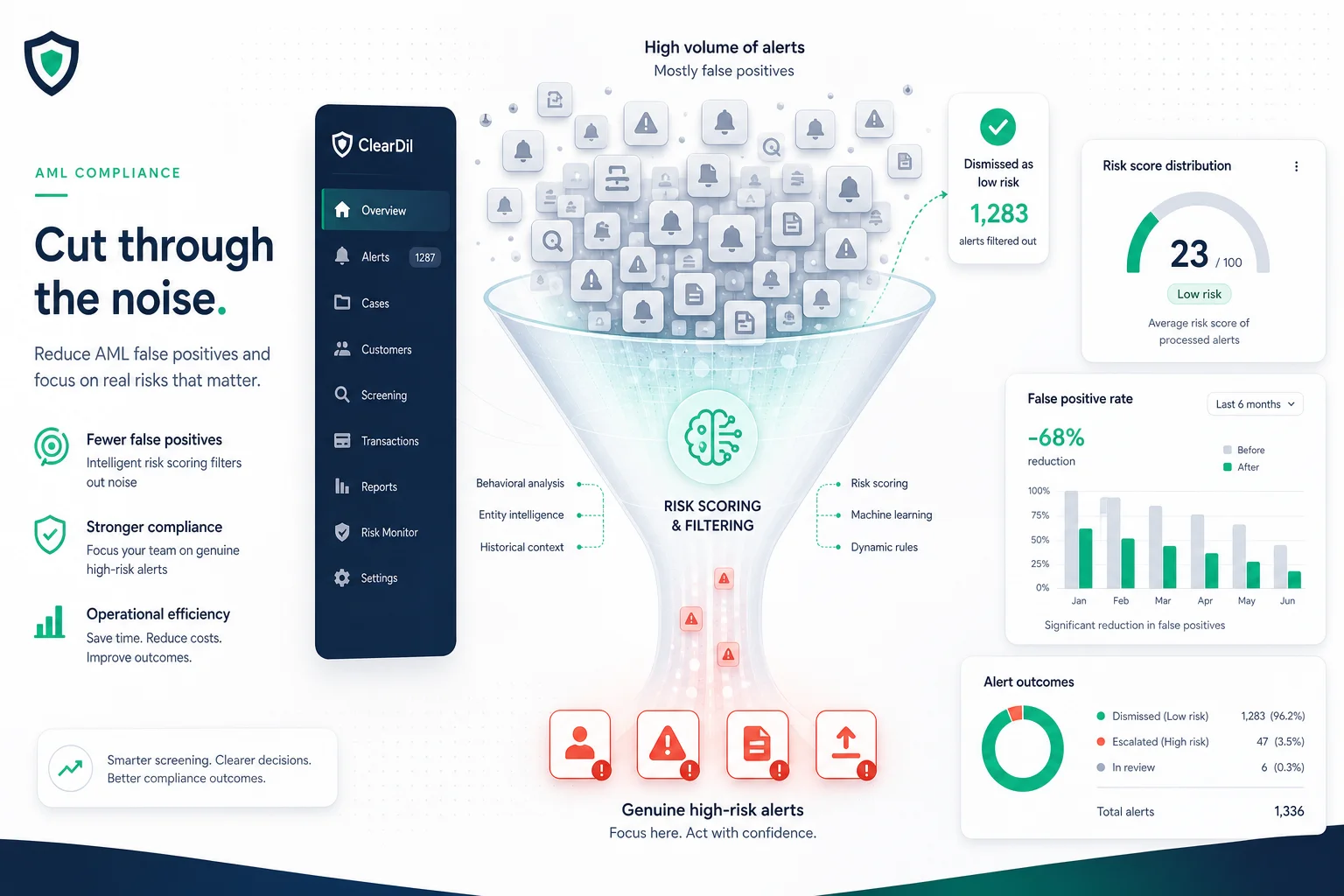
AML false positives are one of the most persistent drains on compliance operations. When screening and transaction monitoring systems flag innocent customers and transactions, investigators spend hours on cases that lead nowhere — while genuinely suspicious activity risks getting buried in the backlog.
This guide explains what causes false positives, how alert fatigue undermines AML operations, and what teams can do to improve case management AML workflows without weakening regulatory coverage.
What Are AML False Positives?
An AML false positive occurs when an Anti-Money Laundering (AML) system flags a customer, transaction, or activity as suspicious even though no financial crime has occurred.
False positives are one of the biggest operational challenges facing compliance teams today. While AML screening systems and transaction monitoring tools are designed to detect money laundering risks, they often generate large volumes of alerts that ultimately require investigation but result in no suspicious findings.
As regulatory expectations increase and customer volumes grow, many financial institutions struggle to balance effective compliance with operational efficiency.
Why False Positives Are a Growing Problem
Modern AML programs rely on sanctions screening, Politically Exposed Person (PEP) screening, adverse media monitoring, transaction monitoring, and customer risk assessments.
While these controls are essential, traditional systems often generate excessive alerts because they rely on rigid rules and limited contextual information.
As a result, compliance teams face:
- Alert overload
- Investigation backlogs
- Higher operational costs
- Slower onboarding processes
- Compliance inefficiencies
- Employee burnout
The challenge is not identifying more alerts. The challenge is identifying the right alerts.
What Causes AML False Positives?
Several factors contribute to excessive false positive rates.
Name Matching Issues
Many AML screening systems rely on fuzzy matching algorithms.
For example, a customer named “Mohammed Ali” may generate multiple potential matches across sanctions lists, watchlists, and PEP databases despite having no connection to those individuals.
Common names often produce large numbers of unnecessary alerts.
Overly Broad Screening Rules
Some organizations configure screening thresholds too aggressively.
While this approach may seem safer from a compliance perspective, it frequently creates large volumes of low-risk alerts that require manual review.
Lack of Customer Context
A transaction that appears suspicious for one customer may be perfectly normal for another.
Without customer-specific risk profiles built through KYC onboarding, screening systems may generate alerts based solely on transaction characteristics rather than actual risk.
Poor Data Quality
Incomplete customer records, inconsistent data formats, and missing identifiers can significantly increase matching errors.
Better data quality — supported by a reliable KYC API — often leads directly to better alert accuracy.
Static Rules-Based Monitoring
Traditional transaction monitoring systems frequently rely on fixed thresholds.
For example:
- Transactions above a certain amount
- Specific transaction frequencies
- Geographic triggers
While useful, these rules often lack the flexibility required to distinguish between normal and suspicious behavior.
The Cost of AML False Positives
False positives create more than just operational inconvenience.
They directly impact compliance effectiveness and business performance.
Higher Compliance Costs
Every alert requires review, documentation, and investigation.
As alert volumes increase, organizations must allocate additional personnel and resources to maintain compliance obligations.
Slower Customer Onboarding
Customers expect fast onboarding experiences.
Excessive screening alerts can delay account openings, payment approvals, and business onboarding (KYB) processes.
Long onboarding times can negatively affect customer acquisition and conversion rates.
Reduced Investigator Productivity
When compliance analysts spend most of their time reviewing harmless alerts, they have less capacity to investigate genuinely suspicious activity.
This creates the risk that important cases receive insufficient attention.
Alert Fatigue
Alert fatigue occurs when investigators are overwhelmed by large volumes of low-quality transaction monitoring alerts.
Over time, this can reduce efficiency, lower morale, and increase the risk of human error.
What Is Alert Fatigue in AML Compliance?
Alert fatigue is a condition in which compliance teams become overwhelmed by excessive numbers of alerts, many of which ultimately prove irrelevant.
Organizations experiencing alert fatigue often encounter:
- Growing investigation backlogs
- Longer case resolution times
- Increased staffing requirements
- Higher compliance costs
- Greater operational risk
Reducing false positives is one of the most effective ways to combat alert fatigue and strengthen the overall AML investigation workflow.
How a Risk-Based AML Approach Reduces False Positives
Modern compliance programs increasingly rely on risk-based AML frameworks rather than purely rules-based systems.
Instead of treating every customer equally, risk-based approaches incorporate:
- Customer risk profiles
- Geographic risk factors
- Transaction history
- Industry classification
- Beneficial ownership information
- Ongoing monitoring results
This additional context helps prioritize genuinely suspicious activity while reducing unnecessary alerts.
Benefits of Risk-Based Monitoring
| Traditional AML Monitoring | Risk-Based AML Monitoring |
|---|---|
| Fixed thresholds | Dynamic risk scoring |
| High alert volumes | Prioritized alerts |
| Limited context | Customer-specific insights |
| More false positives | Improved accuracy |
| Greater manual effort | More efficient investigations |
How Modern AML Platforms Improve Alert Accuracy
Technology has become a critical component of effective compliance operations.
Modern AML compliance software for financial institutions combines multiple data sources and intelligent risk scoring models to improve detection quality.
Advanced Customer Screening
Modern screening systems evaluate:
- Sanctions exposure
- Politically Exposed Persons (PEPs)
- Adverse media findings
- Watchlist matches
- Beneficial ownership structures
By combining these signals, organizations gain a more complete understanding of customer risk. Learn more in our guide to AML screening explained.
Dynamic Risk Scoring
Instead of relying solely on static rules, modern platforms calculate risk scores based on multiple variables.
Higher-risk customers receive greater scrutiny, while lower-risk customers move through compliance workflows more efficiently.
Ongoing Monitoring
Customer risk profiles can change over time.
Continuous monitoring allows organizations to identify emerging risks without repeatedly reviewing low-risk customers unnecessarily.
Machine Learning and Pattern Recognition
Advanced AML platforms increasingly use machine learning to identify suspicious behaviors and improve alert quality.
These technologies help reduce AML false positives and repetitive investigations while supporting stronger compliance outcomes.
The real cost of alert overload
Best Practices for Reducing AML False Positives
Organizations looking to improve AML operations should consider the following strategies.
Improve Customer Data Quality
Accurate customer records significantly improve screening precision. Structured KYC compliance data at onboarding reduces matching errors downstream.
Use Risk-Based Customer Segmentation
Different customer groups require different levels of scrutiny.
Continuously Tune Screening Rules
Regular reviews help eliminate unnecessary alerts while maintaining regulatory compliance.
Integrate KYC, KYB, and AML Data
Combining customer identity, beneficial ownership, and risk information improves overall accuracy across retail and business onboarding flows.
Implement Ongoing Monitoring
Continuous monitoring helps focus resources on changing risks rather than repeating low-value investigations.
Industries Most Affected by AML False Positives
False positives impact nearly every regulated industry, including:
- Banks
- Fintech companies
- Payment Service Providers (PSPs)
- Cryptocurrency exchanges
- Insurance providers
- Wealth management firms
- Lending platforms
Organizations with high customer volumes often experience the greatest operational burden from excessive alerts.
Frequently Asked Questions
What is an AML false positive?
An AML false positive occurs when a customer, transaction, or activity is incorrectly flagged as suspicious even though no financial crime has taken place.
Why do AML systems generate so many false positives?
Common causes include broad screening rules, name matching issues, poor data quality, static thresholds, and insufficient customer context.
What is alert fatigue in AML compliance?
Alert fatigue occurs when compliance teams are overwhelmed by large volumes of low-value alerts, reducing operational efficiency and increasing investigation workloads.
How can organizations reduce AML false positives?
Organizations can improve data quality, implement risk-based AML frameworks, continuously optimize screening rules, and use modern compliance technologies with dynamic risk scoring.
What is the relationship between AML screening and false positives?
AML screening systems generate alerts when potential matches are identified. Better screening accuracy helps reduce unnecessary investigations while maintaining compliance.
Can automation reduce false positives?
Yes. Automated screening, risk scoring, and ongoing monitoring solutions can improve alert quality and reduce manual investigation workloads.
Conclusion
AML false positives remain one of the largest operational challenges in financial crime compliance. Excessive alerts increase costs, slow onboarding, and contribute to investigator fatigue.
Organizations that adopt risk-based AML programs, improve customer data quality, and leverage modern compliance technology can significantly reduce false positives while strengthening their overall compliance framework.
The goal of AML operations is not to generate more alerts. It is to identify the right risks at the right time and enable compliance teams to act effectively.